

no you are a fool

Struggle for Hindu Existence
*Hindu Rights to Survive with Dignity & Sovereignty *Join Hindu Freedom Movement to make Bharat Hindu Rashtra within this lifetime *Jai Shri Ram *Jayatu Jayatu Hindu Rashtram *Editor: Upananda Brahmachari.
Calcutta HC dismisses challenge to Bengal Govt notification restricting cattle slaughter on Bakr Eid.
Calcutta High Court Upholds Bengal’s Cattle Slaughter Curbs Ahead of Bakrid, Says Cow Sacrifice “Not an Essential Religious Requirement”.
Upananda Brahmachari | HENB | New Delhi | May 22, 2026:: The Calcutta High Court on Thursday refused to stay the West Bengal government’s restrictions regulating cattle slaughter ahead of Bakrid (Eid-ul-Adha), holding that the State’s May 13 notification merely enforced provisions that already existed under law and earlier judicial directions. At the same time, the Court directed the government to expressly clarify that cow sacrifice is not an essential religious requirement under Islam and that slaughter in public spaces is prohibited.
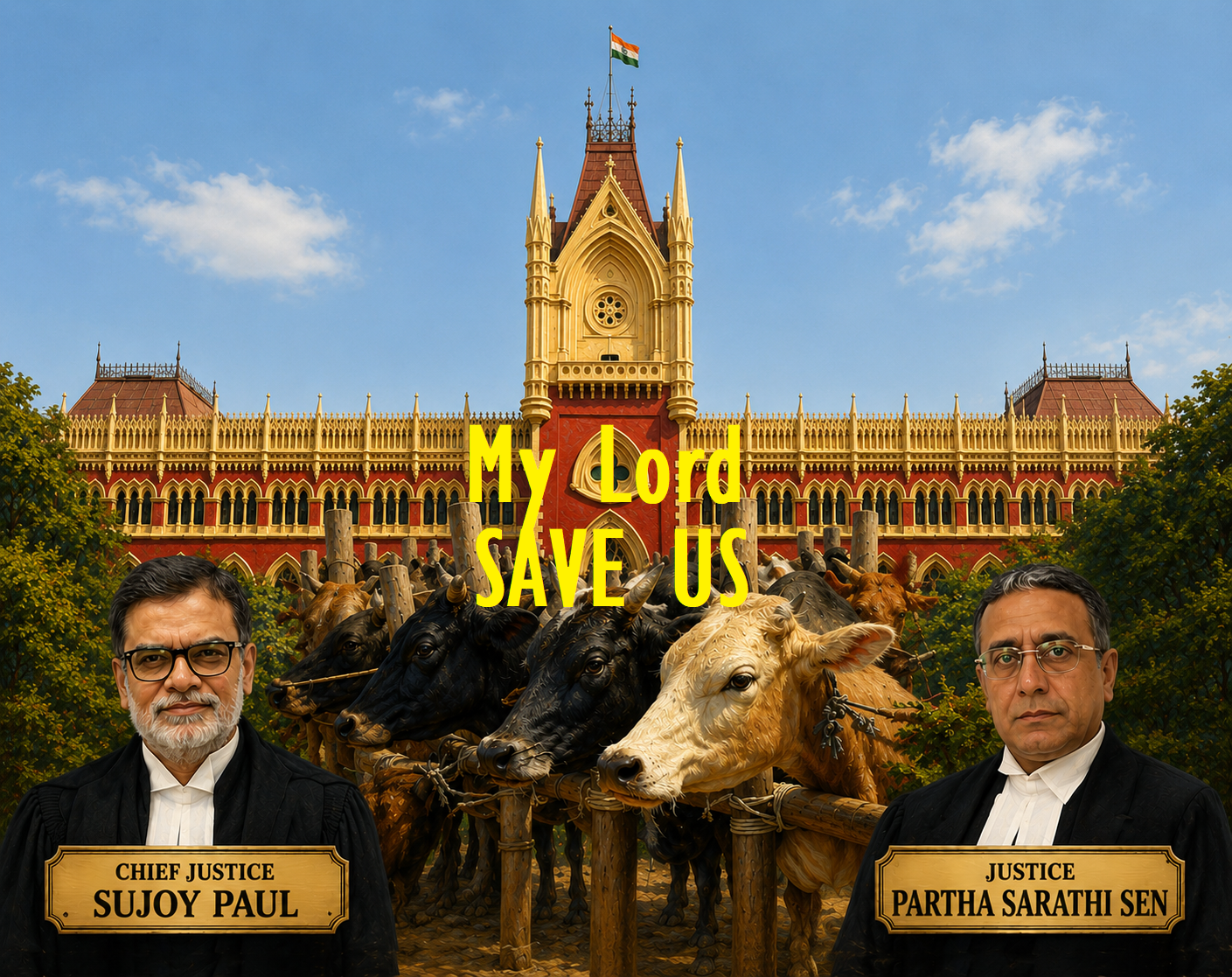
A Division Bench comprising Chief Justice Sujoy Paul and Justice Partha Sarathi Sen upheld the State’s notification issued on May 13 under the West Bengal Animal Slaughter Control Act, 1950, which bars the slaughter of cows, bulls, bullocks, calves and buffaloes without a valid “fitness certificate.” The Court ruled that no interim relief was warranted against the notification and declined to suspend its implementation before Eid-ul-Adha.
Court Says Notification Implements Earlier HC Directions
A major reason cited by the High Court for refusing interim relief was that the May 13 notification was not a fresh restriction but merely an implementation of earlier judicial directions already passed by the Calcutta High Court in 2018.
Referring to the earlier case of Rajyashree Chaudhuri v. State of West Bengal, the Bench observed that the conditions laid down in the present notification were substantially identical to the safeguards and restrictions already mandated by a coordinate Bench of the High Court in 2018. The Court stated:
“If the conditions mentioned in the impugned notice are examined in juxtaposition to the conditions mentioned by this Court in WP 328 of 2018, it will be crystal clear that the impugned public notice is issued for implementing the order passed by this Court in WP 328 of 2018.”
The Bench further held that since the 2018 judgment had attained finality and was never challenged, there was no legal basis to stay or quash the State’s notification.
Court Upholds May 13 Notification
The May 13 notification, issued by the West Bengal government, reiterated that slaughter of cattle and buffaloes cannot take place without prior certification from authorities. The certificate is to be jointly issued by the municipal chairman or panchayat samiti head along with a government veterinarian and is permitted only if the animal is above 14 years of age, permanently incapacitated, injured, disabled, or suffering from an incurable disease. Slaughter is allowed only in municipal or officially designated slaughterhouses. Violations may attract imprisonment of up to six months, a fine of up to ₹1,000, or both.
“Cow Sacrifice Not Religious Requirement”: HC Directs Clarification
In a significant direction, the Court ordered the State government to amend the notification and explicitly include two points: first, that slaughter of animals, including cows and buffaloes, in open public spaces is strictly prohibited; and second, that “sacrifice of a cow is no part of the festival of Id-Uz-Zoha and is not a religious requirement under Islam.” The Bench referred to the Supreme Court’s judgment in the historic case of Mohd. Hanif Quareshi v. State of Bihar while making this observation.
The Court reiterated that the State may regulate slaughter practices even during religious festivals so long as such regulations do not interfere with constitutionally protected essential religious practices.
CPIM Leader Bikash Ranjan Bhattacharya’s Constitutional Challenge
Senior advocate and CPI(M) leader Bikash Ranjan Bhattacharya mounted a broader constitutional challenge against several provisions of the West Bengal Animal Slaughter Control Act, 1950, particularly Sections 4, 6, 7, 8 and 11. Appearing before the Court, Bhattacharya argued that the legislation had become outdated and impractical in the context of modern agricultural and economic realities.
He contended that the law was enacted during a period when agriculture was heavily dependent on cattle and buffaloes, but technological advancement and mechanisation had significantly altered those conditions. Describing the statute as a “dead letter law,” Bhattacharya argued before the Bench that prolonged non-implementation had weakened the practical relevance of the legislation. He also highlighted what he described as procedural absurdities, including the requirement of ₹1 non-judicial stamp fees for every animal and the alleged lack of adequate slaughterhouse infrastructure across many parts of the State.
However, the High Court declined to grant interim relief on the constitutional challenge, observing that laws enjoy a presumption of constitutionality unless specifically struck down. The Bench stated that the constitutional validity of the provisions would be examined after completion of pleadings and further hearings.
Petitions from TMC, Muslim Orgs Challenging Restrictions Rejected for Interim Relief
The ruling came while hearing a batch of PILs and writ petitions challenging the Bengal government’s move to strictly enforce cattle slaughter regulations before Bakrid. Among those who approached the Court were TMC MP Mahua Moitra, TMC MLA Adv. Akhruzzaman, Muslim organisations and cattle-trader groups, who argued that the notification effectively disrupted Bakrid sacrifices and adversely affected religious practice and rural livelihoods.
Senior advocate Shadan Farasat, appearing for Mahua Moitra, argued before the Bench that qurbani in Islam traditionally involves healthy animals and urged the Court to permit exemptions under Section 12 of the 1950 Act for Eid-ul-Adha. According to submissions recorded during proceedings, he argued that without such exemptions, the purpose of the statutory exemption clause would become meaningless.
State Told to Decide Exemption Requests Within 24 Hours
Even while refusing to suspend the notification, the Court granted limited procedural relief by directing the State government to decide, within 24 hours, any exemption requests made under Section 12 of the 1950 Act in view of the approaching Eid festival. The provision allows the government to consider exemptions for religious purposes, and the Bench instructed authorities to take a timely decision because Bakrid was imminent.
Political Reactions and Continuing Debate
The ruling triggered political responses across party lines. Former Trinamool Congress leader and MLA Humayun Kabir reportedly stated that qurbani would proceed despite restrictions, arguing that the practice forms part of religious observance. Meanwhile, leaders of the ruling BJP in West Bengal said illegal slaughterhouses or violations of the law would not be allowed.
The judgment has intensified political and social debate in West Bengal over balancing religious freedom, animal welfare, public order, and enforcement of existing laws during Eid-ul-Adha. While petitioners argued the rules made traditional sacrifice difficult, the State maintained that the notification merely operationalised existing statutory provisions and earlier court directions rather than introducing a new prohibition.
Hindu Sentiments, Animal Cruelty and Protection of Animal Resources Ignored by All
Finally, the Calcutta High Court dismissed the challenge filed by a united front of TMC, CPI(M), Congress, AJUP (Aam Janata Unnayan Party), ISF (Indian Secular Front), Citizen Forum For Social Justice, butchers’ confederations and several Muslim organisations including All India Mutawalli Association, West Bengal State Jamiat-E-Ulama against the West Bengal government’s notification restricting cattle slaughter during Bakrid. The case also exposed how none of the petitioners aggressively pushing for large-scale cow slaughter during Eid addressed the issues of Hindu sentiments hurt by open cow slaughter, indiscriminate bloodshed in public spaces, rampant animal cruelty, or the growing threat to valuable cattle resources. Despite demanding exemptions for Bakri Eid falling on May 27–28, the petitioners virtually ignored Article 48 of the Constitution of India, which specifically directs the State to preserve and improve cattle breeds and prohibit the slaughter of cows, calves and other milch and draught cattle.
Art 48. Organisation of agriculture and animal husbandry
The State shall endeavour to organise agriculture and animal husbandry on modern and scientific lines and shall, in particular, take steps for preserving and improving the breeds, and prohibiting the slaughter of cows and calves and other milch and draught cattle.
Supporters of the restrictions argued that while political parties united to oppose the slaughter curbs, they remained unwilling to acknowledge concerns relating to public order, protection of animal resources, scientific animal husbandry and the religious sensitivities of the Hindu community.
…
_Agency Inputs.
2 comments on “Calcutta HC dismisses challenge to Bengal Govt notification restricting cattle slaughter on Bakr Eid.”
Leave a Reply

Wishing all success to his journey
[…] Hindu Ekta Rath Yatra 3.0 has been announced under Bageshwar Dham’s Dhirendra Shastri as a 500-km mobilisation through five…
[…] On 10 October 2026, West Bengal Chief Minister Suvendu Adhikari gave CPM leader Bikash Bhattacharya …. That establishes the…
[…] concrete case shows why precision matters. On 9 October 2026, Hindu protesters in the Dum Dum area were reported…


Pingback: Calcutta HC upholds Bengal’s Bakri Eid cattle curbs, says cow sacrifice non-essential – DharmaRenaissance Blog
Pingback: Bakri Eid Cattle Restrictions: The Article 25 Balance – DharmaRenaissance Blog