

[…] distinction matters because the dispute now includes a VHP demand that Muslims not attend Garba and Dandiya, alongside reported…

Struggle for Hindu Existence
*Hindu Rights to Survive with Dignity & Sovereignty *Join Hindu Freedom Movement to make Bharat Hindu Rashtra within this lifetime *Jai Shri Ram *Jayatu Jayatu Hindu Rashtram *Editor: Upananda Brahmachari.
Hindu civilisation declined due to political takeover, internal shortcomings: UPSC Secretary Shashi Ranjan Kumar.
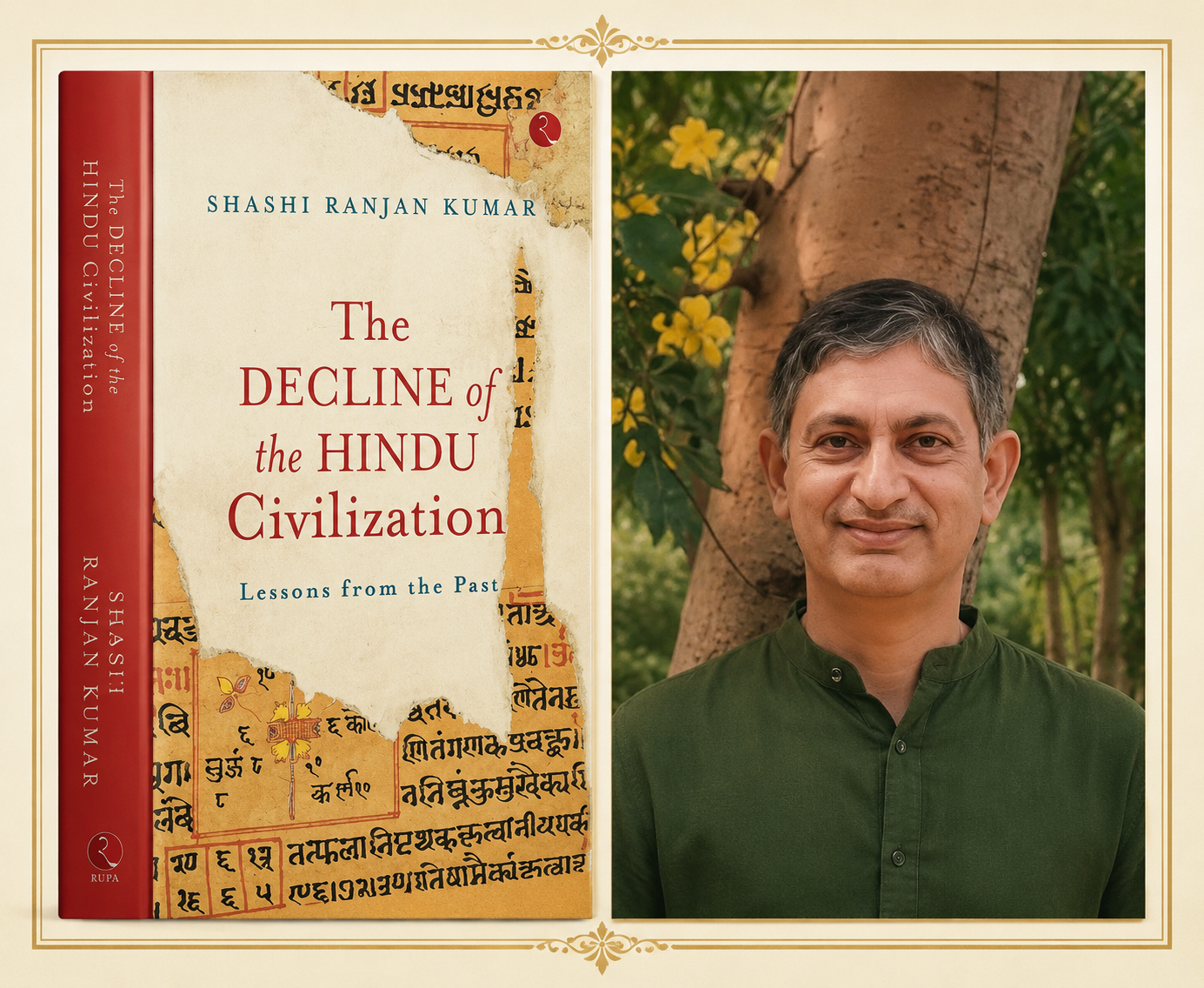
Political Subjugation, Internal Flaws Led to Hindu Civilisation’s Decline, Says UPSC Secretary; Debate Rekindled on India’s Enduring Legacy and Civilisational Journey.
B Upendran | HENB | Bengaluru | May 23, 2026:: Political subjugation and internal shortcomings were among the principal causes behind the decline of Hindu civilisation, UPSC Secretary and author Shashi Ranjan Kumar said on Saturday, while underlining the need for India to engage with its past through honesty, critical inquiry and intellectual openness.
Kumar was speaking at a dialogue event in Bengaluru on his book, The Decline of Hindu Civilization: Lessons from the Past, where he argued that India’s history should not be viewed merely as a sequence of political transitions, but as a long and continuous civilisational journey marked by advances in science, mathematics, philosophy and culture.
The event, organised at Bangalore University’s Central College campus, brought together academicians, journalists, students and scholars. It was jointly hosted by the Department of Communication of Bangalore University, the Department of Journalism and Mass Communication of Dr Manmohan Singh Bengaluru City University, the Karnataka State Journalism and Mass Communication Teachers Association, and the Indian Communication Congress.
Kumar stressed that the concept of Anvikshaki — critical inquiry and analytical reasoning — formed the foundation of India’s intellectual traditions. According to him, ancient India achieved remarkable milestones in mathematics, astronomy, medicine and philosophy through a culture that valued questioning and systematic thought.
He highlighted India’s contributions to global knowledge, particularly the development of the decimal system and the conceptualisation of zero as a number. “The need to comprehend the vastness of the universe forced abstraction,” Kumar said, explaining that Indian mathematical traditions advanced beyond many contemporaneous civilisations by embracing conceptual thinking. He also noted that Indian scholars understood negative numbers at a time when Arab mathematicians were reluctant to accept them.
Drawing comparisons between civilisations, Kumar argued that Indian science developed differently from Greek traditions. While Greek science relied heavily on deductive reasoning and physical models, Indian scientific thought focused more on empirical observation, algorithms and practical methods. He extended this comparative approach to medicine and aesthetics, pointing to advanced surgical practices, including forms of plastic surgery, that emerged in ancient India.
However, Kumar warned that these intellectual traditions gradually weakened due to a combination of external political domination and internal failings. “The rich intellectual traditions waned due to political subjugation and internal flaws,” he said.
He argued that strategic and technological thinking declined after the era of Kautilya and his Arthashastra, resulting in India falling behind the rapid scientific and military advancements taking place in Europe. Kumar said Indian rulers often failed to adapt to changing political realities and evolving methods of warfare, a theme he explores in a chapter titled “War is Deception.”
According to Kumar, India’s geographical advantages — fertile lands and the protective barrier of the Himalayas — may also have contributed to intellectual complacency and reduced incentives for outward exploration. He suggested that civilisations decline not because of one catastrophic event, but because of “the accumulation of numerous small, uncorrected mistakes.”
Kumar also connected historical decline with contemporary concerns, cautioning that declining standards in infrastructure and construction reflected a growing social acceptance of mediocrity over excellence. He said societies that stop valuing precision, innovation and discipline risk long-term stagnation.
The UPSC Secretary’s remarks echoed themes he had earlier articulated during the January 2026 launch of his book at the India International Centre in New Delhi. At the launch event, Kumar rejected what he described as two dominant distortions of Indian history — the glorification of the past as an era of flawless achievement and the wholesale dismissal of traditional knowledge as superstition.
“The past lives on, in memory, in ruins, and in the ways it continues to shape us. The only way forward is to face it, its beauty as well as its failures, with honesty,” Kumar had said.
He explained that his work seeks to navigate between ideological extremes by acknowledging both India’s extraordinary intellectual accomplishments and the reasons for its gradual decline. Structured into four sections — The Zenith, The Decline, The Defeats, and The Reasons — the book examines the weakening of Hindu civilisation across politics, culture, social institutions and intellectual life.
Kumar said the book avoids presenting Hindu civilisation as a monolithic or uniform entity. Instead, he described it as a pluralistic tradition encompassing diverse languages, philosophies and cultural practices. “Civilisation here means plurality,” he said, cautioning against reducing history to rigid ideological identity.
The author drew extensively on primary historical sources, including Chachnama, Tabaqat-i-Nasiri, Kitab-i-Yamini, Futuh al-Buldan, and Kitab al-Hind, along with travel accounts of medieval scholars and chroniclers. He said the study places Indian civilisation alongside Greek and Chinese traditions rather than treating it in isolation.
“A civilisation does not decline overnight,” Kumar observed during the discussion. “It declines when curiosity narrows.”
Is Hindu Civilization actually declined?
At the same time, the broader debate around the idea of a “decline” of Hindu civilisation continues to evoke differing perspectives among scholars and proponents of the Indian Knowledge System (IKS). Many thinkers argue that Hindu civilisation remains one of the world’s oldest living civilisations, continuously evolving through adaptation, resilience and cultural continuity rather than disappearing like several ancient civilisations.
Supporters of this view point to the enduring legacy of Vedic traditions, the continuity of spiritual practices, and recent archaeological explorations such as Rakhigarhi as evidence of a civilisation that has transformed itself across ages while retaining its philosophical core. Unlike ancient Mesopotamian, Byzantine, Greek or Egyptian civilisations, which largely survive through historical memory and archaeological remains, Hindu civilisation, they argue, continues to live through its social traditions, festivals, languages, rituals and systems of thought.
According to this perspective, the enduring strength of Hindu civilisation lies in its plurality, adaptability and capacity for assimilation. Its followers maintain that Sanatan values and traditional practices have enabled it to absorb external influences, modernity and changing political realities without losing its essential identity. Rather than viewing Hindu civilisation as a fallen or “dead” civilisation, proponents describe it as a dynamic and living cultural continuum that continues to shape Indian society and global philosophical discourse.
The event sparked extensive discussions among participants on the relevance of historical self-examination, civilisational memory and intellectual renewal in shaping modern India.
..
_Agency Inputs.
2 comments on “Hindu civilisation declined due to political takeover, internal shortcomings: UPSC Secretary Shashi Ranjan Kumar.”
Leave a Reply


Pingback: Political Subjugation, Internal Faultlines, and Hindu Civilisation: An Evidence-Based Reappraisal – DharmaRenaissance Blog
Pingback: Hindu Civilisational Continuity Under Political Subjugation – DharmaRenaissance Blog