

[…] [Disclaimer: The content in this RSS feed is automatically fetched from external sources. All trademarks, images, and opinions belong…

Struggle for Hindu Existence
*Hindu Rights to Survive with Dignity & Sovereignty *Join Hindu Freedom Movement to make Bharat Hindu Rashtra within this lifetime *Jai Shri Ram *Jayatu Jayatu Hindu Rashtram *Editor: Upananda Brahmachari.
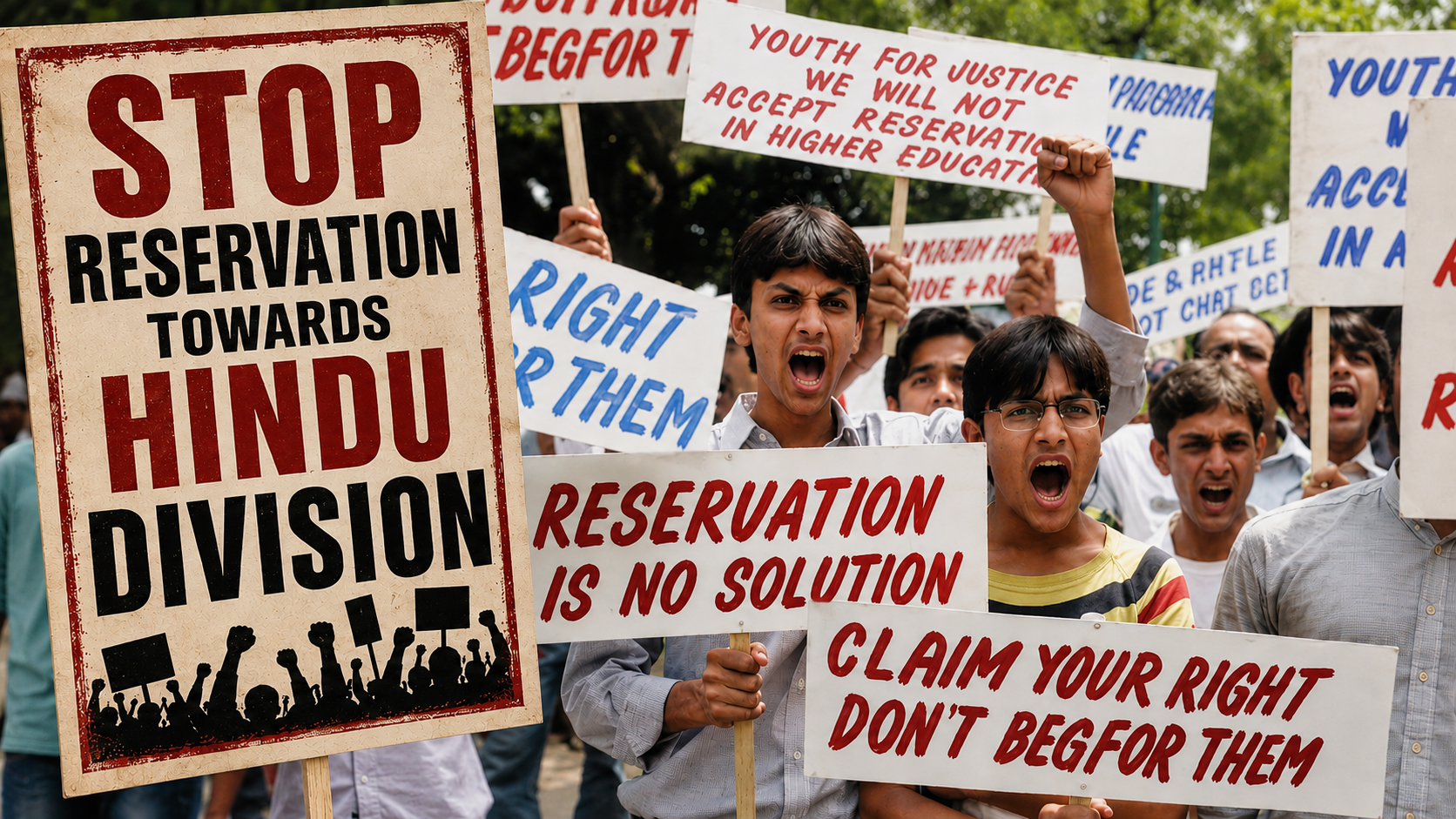
Reservation and Hindu Unity: Time to Bridge the Divide towards making greater Hindu unity.
Seventy-Five Years of Reservation: Time for a National Review, Not a Hindu Divide.
~ Upananda Brahmachari.
More than seven decades after India adopted its Constitution, the country’s reservation policy remains one of the most consequential—and most debated—pillars of social justice. Designed to address centuries of discrimination and social exclusion, the system has undeniably expanded educational opportunities, public employment, and political representation for millions from historically disadvantaged communities.
Yet, after 75 years of implementation, an important national question deserves thoughtful discussion: Has the reservation system evolved in a way that fully meets its original objectives, or is it time for a comprehensive policy review?
An Expanding Framework
When the Constitution came into force in 1950, the Scheduled Castes (SC) list comprised around 607 communities, while the Scheduled Tribes (ST) list included 241 tribes. Over the decades, these lists have expanded significantly. Today, the SC list includes approximately 1,200 communities, while the ST list has grown to 744 tribes. Likewise, the list of Other Backward Classes (OBCs), initially numbering around 3,000 communities, now exceeds 5,000. Such claims could not be independently verified. However, these were emphatically made by Dr. Neha Lal Das, a socio-political activist who advocates Hindu unity through reforms to what she describes as faulty reservation policies.
The steady expansion of these lists raises several policy questions. Does this growth reflect improved identification of historically disadvantaged communities, or does it suggest that social backwardness continues to persist despite decades of affirmative action? Are new communities being added because inequalities remain unresolved, or because political and administrative realities have changed over time?
These are questions that deserve evidence-based public debate rather than ideological polarization.
Measuring Success Beyond Numbers
The principal objective of reservation was not merely to provide quotas but to enable historically marginalized communities to achieve social equality, educational advancement, and economic empowerment.
This naturally leads to another question: if reservation has been in place for more than seven decades, why do demands for inclusion continue to grow instead of decline?
Supporters argue that persistent inequalities, caste-based discrimination, unequal access to quality education, and economic disparities justify the continuation and expansion of affirmative action. They point to improved representation in government services, educational institutions, and legislatures as evidence that reservation has played a transformative role.
Critics, however, contend that the absence of clearly defined benchmarks for graduating communities out of reservation raises concerns about the long-term effectiveness of the policy. They argue that periodic evaluation of beneficiary groups, socio-economic progress, and measurable outcomes should become an integral part of India’s affirmative action framework.
Social Cohesion and Emerging Fault Lines
Another dimension of the debate concerns social harmony. Some observers argue that expanding reservation categories have intensified competition for limited educational seats and government jobs, contributing to resentment between reserved and non-reserved sections of society.
Whether these tensions have significantly affected social cohesion remains a matter of debate. Many scholars argue that inequality—not reservation itself—is the principal source of social friction. Others believe that the political mobilisation around reservation has deepened identity-based divisions.
If India’s long-term objective is national unity alongside social justice, policymakers must ask how affirmative action can continue to uplift disadvantaged communities without creating new social fault lines.
The Debate Over Religious Communities
The inclusion of certain Muslim and Christian communities within reservation categories also continues to generate public discussion.
Under the Constitution, Scheduled Caste status is presently restricted by law to Hindus, Sikhs, and Buddhists, while OBC reservation is based on social and educational backwardness rather than religion. Consequently, several Muslim and Christian communities have been included in OBC lists where they meet the prescribed criteria.
Supporters argue that such inclusion is constitutionally valid because backwardness—not religion—is the determining factor for OBC classification. Critics, however, question whether the current framework is being implemented consistently and transparently across states. These differing perspectives underline the importance of objective data, judicial scrutiny, and constitutional safeguards.
A Policy Meant to Evolve
Reservation was introduced as an instrument of social transformation, with the expectation that constitutional safeguards and public policies would evolve as society progressed. Over the decades, Parliament, state governments, commissions, and the judiciary have continually shaped its scope and implementation.
This raises a broader policy question: should India undertake a comprehensive, evidence-based review of the reservation system to assess its achievements, identify its shortcomings, and determine the way forward?
Such a review need not weaken affirmative action. On the contrary, it could strengthen public confidence by ensuring that benefits reach those who need them most, while making the system more transparent, accountable, and outcome-oriented.
Towards Social Justice with Social Unity
India’s constitutional vision is built upon two complementary ideals: social justice and national unity. Neither should come at the expense of the other.
A mature democracy must periodically evaluate its public policies in light of changing realities. The debate on reservation should therefore move beyond political rhetoric and electoral calculations. It should be informed by credible data, constitutional values, rigorous research, and a shared commitment to building an inclusive society.
The ultimate goal should not simply be the expansion or contraction of reservation, but the creation of an India where every citizen enjoys equal dignity, equal opportunity, and equal access to education, employment, and justice. Until that goal is achieved, the conversation on reservation will remain both necessary and consequential—but it must always be guided by facts, fairness, and the larger national interest.
If India’s constitutional vision seeks to achieve both social justice and national unity, these objectives must reinforce—not undermine—each other. Any public policy that shapes the lives of millions should be subject to periodic, evidence-based review to ensure that it continues to serve its intended purpose while adapting to changing social realities. The conversation on reservation, therefore, should move beyond political rhetoric and electoral calculations toward a constructive national dialogue. If genuine social harmony and fraternity are to be strengthened, policymakers, scholars, and civil society must work together to ensure that affirmative action empowers the truly disadvantaged while fostering greater social cohesion. A society united by equality of opportunity, mutual respect, and constitutional values will ultimately be stronger than one divided by enduring social and political fault lines.
The Question of Hindu Social Cohesion
One of the most debated socio-political implications of the reservation system is its perceived impact on social cohesion within the Hindu community. Some scholars, social reformers, and public commentators argue that the continued expansion of reservation categories has, over time, reinforced caste identities rather than diminished them. They contend that competition over quotas in education and public employment has contributed to a sense of division between reserved and non-reserved sections of Hindu society, potentially weakening broader social solidarity. Others disagree, arguing that the deeper causes of such divisions lie in historical caste inequalities and uneven access to opportunities, rather than in reservation itself. The challenge before policymakers, therefore, is not merely to preserve affirmative action for those who genuinely require it, but also to ensure that public policy promotes both social justice and greater social cohesion. A system that simultaneously uplifts disadvantaged communities while encouraging a shared sense of national and social unity would be more consistent with the Constitution’s vision of equality, fraternity, and inclusive development.
…
Inputs from X handle of Dr Neha Lal Das.
One comment on “Reservation and Hindu Unity: Time to Bridge the Divide towards making greater Hindu unity.”
Leave a comment


Pingback: Reservation Policy Without Fracturing Hindu Social Unity – DharmaRenaissance Blog