

Update:Jamia University orders student union polls within 15 days of constitution approval; two students continue hunger strike.See link: https://www.thehindu.com/news/cities/Delhi/jamia-university-orders-student-union-polls-within-15-days-of-constitution-approval-two-students-continue-hunger-strike/article71625645.ece .

Struggle for Hindu Existence
*Hindu Rights to Survive with Dignity & Sovereignty *Join Hindu Freedom Movement to make Bharat Hindu Rashtra within this lifetime *Jai Shri Ram *Jayatu Jayatu Hindu Rashtram *Editor: Upananda Brahmachari.
‘No Room for Bhagwat’: US Interfaith Groups Oppose RSS Chief’s Upcoming Madison Square Garden Speech.
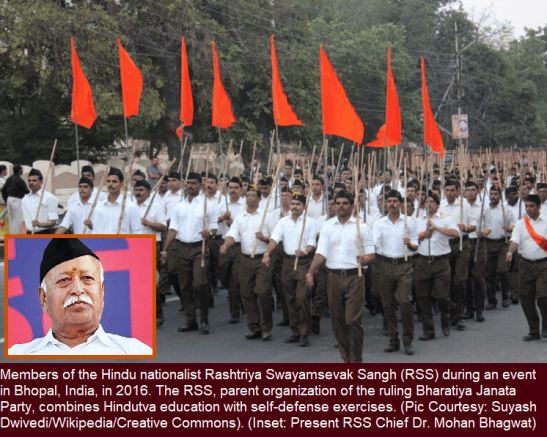
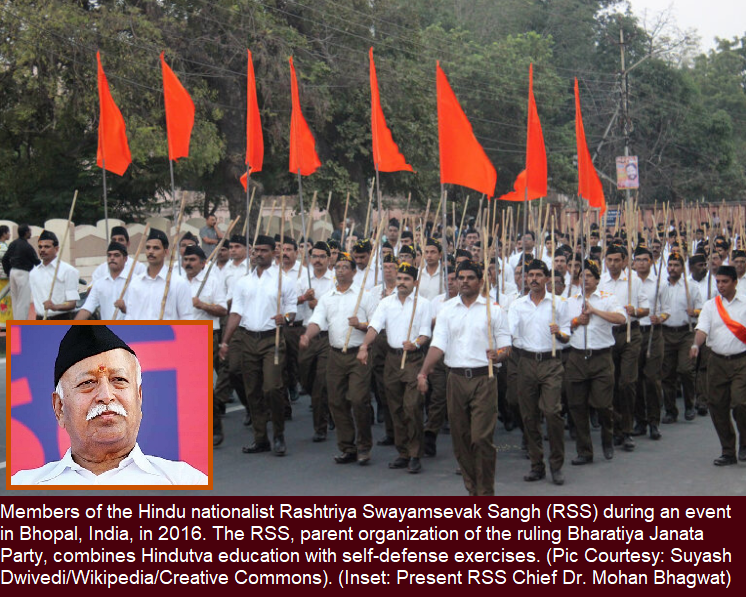
‘No Room for Bhagwat’: Mamdani-Backed US Interfaith Bloc Targets RSS Chief Despite His ‘Same DNA’ and Inclusive Hindu Rashtra Outreach.
Upananda Brahmachari | HENB | New Delhi | Aug 26, 2026:: A growing political and interfaith controversy has erupted in New York ahead of Rashtriya Swayamsevak Sangh (RSS) chief Mohan Bhagwat’s scheduled address to around 5,000 members of the Indian-American community at Madison Square Garden on August 29, with Mayor Zohran Mamdani publicly declaring that he does not support the event.
Mamdani, while opposing the rally, acknowledged that the city may not have the legal authority to cancel the privately organised programme. His remarks came as a coalition of faith leaders, religious advocates and progressive organisations gathered outside New York City Hall on Tuesday, August 25, demanding opposition to Bhagwat’s appearance.
The controversy has placed Bhagwat and the RSS at the centre of a fresh American debate over Hindutva, Hindu identity and the political influence of the Indian diaspora.
Critics of the RSS describe its ideology as exclusionary and Hindu nationalist. Hindu American supporters of Bhagwat, however, argue that the campaign against his visit represents an attempt to stigmatise Hindu nationalism and, by extension, Hindu civilisational identity.
The opposition is particularly notable because Bhagwat himself has repeatedly presented Hindutva as an inclusive civilisational idea rather than a religious doctrine that excludes Muslims. In 2018, he said that a Hindu Rashtra does not mean there is no place for Muslims and that accepting Muslims is part of Hindutva.
More recently, Bhagwat has repeatedly invoked the idea of a shared ancestry between Hindus and Muslims, describing them as descendants of the same ancestors, i.e. same DNA theory.
Mamdani Opposes the Madison Square Garden Event
Speaking at a news conference, Mamdani said he did not support the planned rally but questioned whether the city had jurisdiction to prevent a private event from taking place.
Mamdani also framed his opposition in terms of his understanding of India as a pluralistic and secular society.
The mayor’s intervention has added political weight to protests already being organised by groups critical of the RSS and Hindutva. Reuters reported that Mamdani described the RSS’s vision as exclusionary, while the RSS rejects allegations that it promotes intolerance and describes itself as a cultural organisation working to unite Hindus.
The development is significant because Mamdani is New York’s first Indian-American mayor and has previously been sharply critical of Prime Minister Narendra Modi.
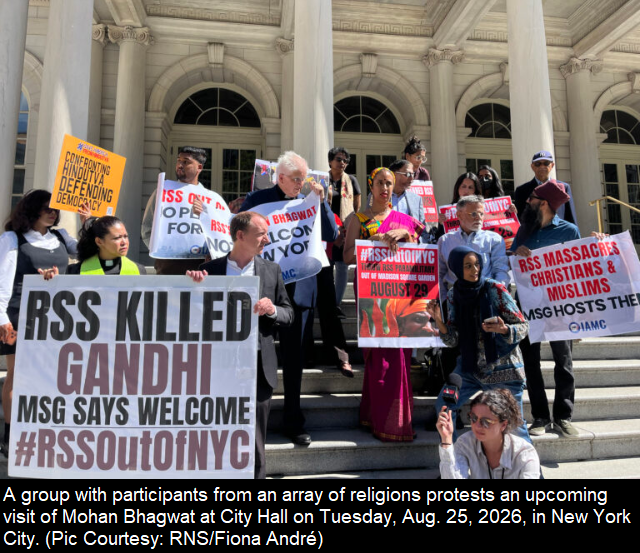
‘No Room for Mohan Bhagwat and RSS Hatred’
Brad Lander, a New York Democrat and former New York City comptroller, also spoke against Bhagwat’s appearance.
“There is no room for Mohan Bhagwat and RSS hatred in our city,” Lander said, alleging that the RSS had “fomented violence and promoted hatred against Muslims, against Sikhs, against Dalits, against Christians.”
The City Hall gathering was organised by the progressive advocacy organisation Hindus for Human Rights and included representatives of the Indian American Muslim Council, the Interfaith Center of New York, Riverside Church and the New York State Council of Churches.
The coalition portrayed the protest as an interfaith response to what it considers the dangers of Hindu nationalism.
Supporters of Bhagwat, however, see the mobilisation differently, arguing that the convergence of Muslim, Christian, Sikh and progressive organisations against the head of a major Hindu organisation reflects a wider ideological opposition to Hindutva.
Bhagwat’s ‘Same DNA’ Message Comes Under the Spotlight
One of the most striking aspects of the controversy is that Bhagwat’s political and ideological outreach to Muslims has not prevented opposition to his appearance.
Bhagwat has repeatedly spoken about the shared ancestry and cultural roots of Hindus and Muslims. His “same DNA” formulation has been intended to emphasise that religious differences do not erase a common civilisational heritage.
He has also explicitly rejected the interpretation that a Hindu Rashtra would exclude Muslims.
During his 2018 lecture series on Delhi on the future of Bharat, Bhagwat said that “Hindu Rashtra doesn’t mean there’s no place for Muslims” and described Hindutva as a concept encompassing inclusivity and unity in diversity.
Another report from the same period quoted him as saying there could be no Hindu Rashtra without Muslims.
Yet despite this outreach, Bhagwat continues to face strong opposition from sections of the American interfaith and political establishment.
For supporters of the RSS chief, the contradiction is central to the controversy: a leader who publicly argues for the inclusion of Muslims within his conception of Hindu Rashtra is nevertheless being portrayed by his opponents as a symbol of exclusion.
RSS and the Hindutva Debate
Founded in 1925 during British colonial rule, the RSS describes itself as a cultural and social organisation dedicated to strengthening Hindu society.
Its critics describe it as the ideological fountainhead of Hindu nationalism and argue that its influence has contributed to majoritarian politics in India.
The RSS has played a major role in India’s political and social landscape. Several prominent figures associated with the organisation went on to become influential leaders of the Bharatiya Janata Party (BJP), and the RSS is widely regarded as an ideological mentor of the party.
Prime Minister Narendra Modi has long been associated with the RSS, although the organisation itself maintains that it is not a political party.
Critics have accused the RSS and BJP of contributing to discrimination and violence against religious minorities. The RSS and BJP have rejected such allegations.
The broader dispute therefore extends beyond Bhagwat personally. It concerns competing interpretations of Indian nationalism: one rooted in secular constitutional nationalism and another that places India’s Hindu civilisational identity at the centre of national consciousness.
USCIRF Joins the Opposition
Bhagwat’s visit has also drawn criticism from members of the U.S. Commission on International Religious Freedom (USCIRF).
Asif Mahmood, vice chair of USCIRF, criticised the visit and linked the RSS to allegations involving attacks on religious minorities in India.
Commissioner Gene Mills also urged U.S. officials not to extend high-level diplomatic courtesies to RSS leaders.
Mills referred to USCIRF’s reporting on alleged religious-freedom violations involving Hindu nationalist groups and called for sanctions against individuals found responsible for such violations.
USCIRF has repeatedly criticised India’s record on religious freedom and has recommended stronger U.S. action against individuals it believes are responsible for serious violations.
Its position has been strongly contested by Indian authorities and Hindu American advocacy organisations, which have accused the commission of adopting an excessively negative and politically charged view of India.
Hindu American Groups Push Back
Hindu American organisations supporting Bhagwat have rejected the criticism and accused his opponents of conflating Hindu identity with extremism.
The Hindu Policy Research and Advocacy Collective (HinduPACT) condemned USCIRF’s position.
Its founder Ajay Shah accused the commission of abandoning its mandate and promoting what he described as an anti-Hindu narrative.
HinduPACT argued that Bhagwat should be allowed to address American Hindus without being subjected to what it characterised as ideological attacks.
The organisation’s position reflects a broader concern among Hindu Americans that criticism of Hindutva increasingly crosses the line into suspicion or hostility toward Hindu civilisational identity itself.
‘Universal Oneness Celebration’ at MSG
Bhagwat’s appearance is part of the “Universal Oneness Celebration,” being organised as part of the RSS’s centenary-year global outreach.
The programme is intended to highlight themes of unity, harmony, shared heritage and the Sanskritic concept of the world as one family.
The event is expected to bring together representatives of Hindu temples, yoga organisations, cultural institutions and other Hindu American groups.
The RSS’s centenary-year outreach has already attracted considerable international attention, with Bhagwat travelling as part of a programme involving the United States, Canada and the United Kingdom.
Organisers say the New York programme provides Hindu Americans with an opportunity to hear directly from the RSS chief rather than through the interpretations of his critics.
‘Weaponisation’ of Religion
At the City Hall gathering, Lander compared what he described as the political “weaponisation” of Hinduism with forms of religious nationalism elsewhere in the world.
He referred to settler violence in the West Bank and the war in Gaza, while also criticising what he described as Hindutva’s role in India.
Danielle Williams of the Interfaith Center of New York also criticised Madison Square Garden for hosting the event.
She referred to the venue’s history, including the pro-Nazi rally held there in 1939, and argued that the arena should not provide a platform for what she described as fascist or supremacist politics.
Williams compared opposition to Hindutva with criticism of Christian nationalism in the United States.
“These movements are not the same; they come from different religions, histories, and political contexts,” she said. “But we know that the danger of any ideology that says one religious identity should oppress others — that is not religious freedom.”
Muslim and Sikh Groups Demand Bhagwat’s Exclusion
Amin Zama, associate director of the Indian American Muslim Council, called on the U.S. State Department to deny Bhagwat a visa and prevent his appearance.
“We are here to say clearly that New York must not become a stage for normalizing fascist and exclusionary politics,” Zama said.
Japneet Singh, founder of the Sikh Council NY, also called on Mamdani to oppose Bhagwat’s visit.
Singh compared the mayor’s position on Bhagwat with his previous criticism of Israeli Prime Minister Benjamin Netanyahu.
He argued that if Modi’s political record warranted criticism, then the organisation that shaped what Singh described as Modi’s political worldview should also face scrutiny.
Mamdani’s Modi Opposition
Mamdani has previously been outspoken in his criticism of Modi.
During his campaign, he criticised the Indian prime minister and referred to the 2002 Gujarat riots, which took place when Modi was the state’s chief minister.
The Gujarat violence remains one of the most contentious episodes in Modi’s political career. Human-rights organisations and Modi’s political opponents have accused his administration of failing to adequately protect Muslims during the violence, allegations Modi and his supporters have rejected.
Mamdani has also spoken about his own family’s Gujarati Muslim background and his understanding of India as a pluralistic society.
His opposition to Bhagwat’s MSG appearance is therefore consistent with his broader political criticism of Modi and Hindu nationalism.
Raksha Bandhan Adds a Cultural Dimension
Bhagwat’s appearance at Madison Square Garden will take place on August 29, immediately after Raksha Bandhan, the Hindu festival celebrating the bond between brothers and sisters.
Raksha Bandhan falls on August 28 this year, giving the centenary programme an additional cultural significance for Hindu Americans.
For supporters, the event is not merely a political rally but a celebration of Hindu civilisational identity, cultural continuity and community solidarity.
A Coalition Against Bhagwat?
The New York protest has brought together Muslim, Christian, Sikh, interfaith and progressive organisations branded as ‘slective seculars’.
Supporters of Bhagwat argue that the coalition represents an increasingly coordinated opposition to Hindu nationalism in the United States.
Some Hindu activists have alleged that Islamist-oriented organisations, Christian groups critical of Hindutva, sections of the Sikh community and progressive secular organisations are converging against Bhagwat.
However, claims that these groups constitute a formal coordinated anti-Hindu or Islamist alliance remain political allegations and should be distinguished from the documented participation of individual organisations in the protest.
Similarly, allegations concerning financial coordination involving the Council on American-Islamic Relations (CAIR) and claims that such efforts are part of a Muslim Brotherhood-directed campaign are disputed and require independent evidence.
The Irony of Bhagwat’s Outreach
The sharp opposition to Bhagwat’s visit has created an important political irony.
For years, Bhagwat has attempted to present Hindutva as a civilisational framework based on cultural unity rather than religious exclusion. His statements that Muslims share the same ancestry as Hindus and that Hindu Rashtra has a place for Muslims were explicitly intended to counter the charge that Hindutva necessarily means hostility toward Muslims.
Yet the New York protests demonstrate that this message has not persuaded some of his strongest critics.
To Bhagwat’s opponents, the RSS’s historical and political record remains more important than his inclusive rhetoric.
To his supporters, the continued portrayal of Bhagwat as an extremist despite his repeated appeals for Hindu-Muslim fraternity is evidence that criticism of the RSS has become detached from what its present leadership actually says.
That disagreement is now playing out on one of the world’s most prominent stages.
A Test for Hindu American Assertiveness
Bhagwat’s August 29 appearance at Madison Square Garden is therefore shaping up as more than an RSS centenary event.
It has become a test of how confidently Hindu Americans can assert their civilisational identity in the public sphere without being portrayed as endorsing religious discrimination.
For critics, the event represents the internationalisation of an ideology they consider exclusionary.
For supporters, it represents the right of Hindu Americans to celebrate their heritage, hear their religious and cultural leadership directly, and participate openly in discussions about India’s civilisational identity.
The fact that Bhagwat’s visit has generated opposition even after his repeated outreach to Muslims through his “same DNA” message and his explicit assertion that Muslims have a place in his conception of Hindu Rashtra has made the controversy particularly significant.
As the August 29 Madison Square Garden event approaches, the confrontation in New York is increasingly becoming a larger argument over the meaning of Hindutva, the future of Hindu identity in the diaspora and whether Hindu nationalism can be discussed in the United States without being automatically equated with extremism.
For the RSS and its supporters, the answer will be tested before thousands of Hindu Americans at Madison Square Garden.
The campaign to oppose Bhagwat’s MSG address should also prompt a wider debate in India. RSS supporters and activists must stand firmly for the principle that Islamist and Evangelist pressure groups cannot dictate the space available to Hindu voices in India, and that the same standard of religious freedom and public expression must apply to all.
…
_Agency Inputs.
One comment on “‘No Room for Bhagwat’: US Interfaith Groups Oppose RSS Chief’s Upcoming Madison Square Garden Speech.”
Leave a Reply

Government Of India should stop the grants immediately. Let them get finance from elsewhere. Sincerely, Rajalakshmi Paramasivam
[…] immediate dispute is framed as a demand to shut Jamia Millia Islamia if alleged anti-Hindu and anti-national activity persists.…
[…] Akhil Bharatiya Sant Samiti, Ganga Mahasabha and Akhada Parishad plan to frame a Hindu Code of Condu…. This establishes…
[…] from a government that speaks in its name. In fact, the dignity of the Kumbh requires both. The Dhami…


Pingback: How Hindus Should Read Opposition to Bhagwat in New York – DharmaRenaissance Blog