

[…] concrete case shows why precision matters. On 9 October 2026, Hindu protesters in the Dum Dum area were reported…

Struggle for Hindu Existence
*Hindu Rights to Survive with Dignity & Sovereignty *Join Hindu Freedom Movement to make Bharat Hindu Rashtra within this lifetime *Jai Shri Ram *Jayatu Jayatu Hindu Rashtram *Editor: Upananda Brahmachari.
‘If Hindus Think Muslims Have No Place, They Cease to Be Hindu’: Bhagwat’s New York Remarks Draw Sharp Criticism.
“If Hindus Think Muslims Have No Place, They Cease to Be Hindu”: Bhagwat’s New York Remark Sparks Question—Who Is He to Define Hindu Identity?
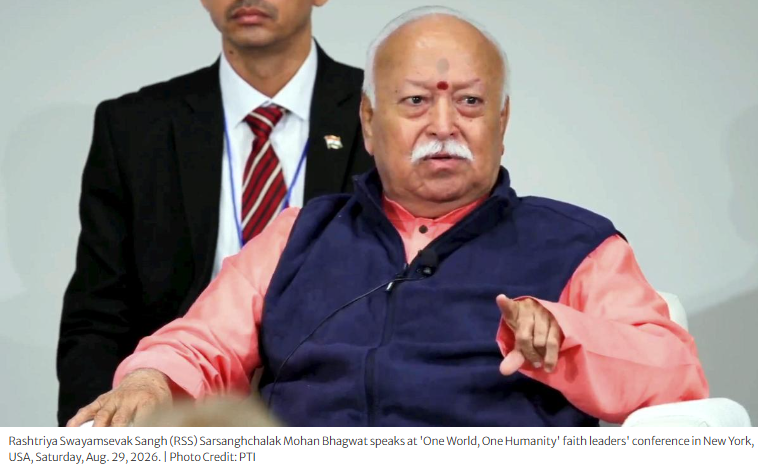
Upananda Brahmachari | HENB | New Delhi | Aug 30, 2026:: Rashtriya Swayamsevak Sangh (RSS) chief Mohan Bhagwat on Saturday said that Hindutva does not envisage a Bharat without Muslims, asserting that a person who believes Muslims should have no place in the country would cease to be a Hindu.
Addressing the ‘One World, One Humanity’ faith leaders’ conference in New York, Bhagwat said that Muslims had asked him during a dialogue about the RSS’s concept of a “Hindu Rashtra” and whether Muslims would be driven out of the country.
“I said, no, that is not Hindutva. If any Hindu thinks that there should be no Muslims in Bharat, he will not remain Hindu,” Bhagwat said.
The statement has generated a sharp ideological debate over the meaning of Hindutva, the RSS’s vision of Hindu Rashtra and, particularly, the question of who has the authority to define Hindu identity and determine the conditions under which a person can be considered a Hindu.
Questions Over Bhagwat’s Religious Authority
Critics argue that Bhagwat’s statement amounts to a religious prescription from a leader who is not a traditional Hindu religious authority.
Bhagwat is the Sarsanghchalak, or chief, of the RSS, a socio-cultural organisation. He holds a degree in veterinary medicine and uses the honorific “Dr.” before his name. However, critics contend that an academic qualification in veterinary science does not confer the authority of a Dharma Guru, Shankaracharya, Acharya or other traditional Hindu spiritual authority.
From this perspective, Bhagwat may articulate the RSS’s understanding of Hindutva, but his statements cannot automatically be treated as universally binding definitions of Hindu Dharma.
The criticism is particularly directed at Bhagwat’s formulation that a Hindu who doesn’t believe Muslims should have no place in Bharat ceases to be a Hindu. Opponents of this view argue that Bhagwat has no religious mandate to establish such a condition for Hindu identity.
Bhagwat’s Message of Religious Pluralism
During his New York address, Bhagwat stressed the unity of humanity despite differences of religion.
“We live in a society where religions may be different, but humanity is one,” he said, adding that India’s tradition has been to provide shelter to people irrespective of their religious identity.
He also cited the RSS’s service activities to support his contention that the organisation does not discriminate on the basis of religion. According to Bhagwat, approximately 1.3 lakh service projects are being carried out by RSS volunteers with the assistance of society.
Recalling an incident in Dadri, Haryana, in which two aircraft from Muslim-majority countries were involved in a collision, Bhagwat said RSS volunteers were among the first to reach the site. Since all the passengers had died, he said, volunteers helped arrange funerals and assisted relatives in identifying the victims.
“We don’t have the thought that they are Muslims,” Bhagwat said, describing the approach of RSS volunteers toward relief and service.
He said the organisation’s philosophy was based on replacing the narrow emphasis on “me” and “mine” with “we” and “ours.”
“Where there is ‘me’ and ‘mine,’ there is no solution. ‘We’ and ‘ours’ is the solution,” he said.
RSS Dialogue With Muslims and Christians
Bhagwat also referred to the RSS’s engagement with minority communities, saying that the organisation had expanded its dialogue with Muslims and Christians in Bharat after 2018.
“Dialogue is the first step, and service is another step,” he said.
He invoked the example of Ramakrishna Paramahamsa, who, according to Bhagwat, practised different religious traditions, including Islam and Christianity. Bhagwat cited the well-known formulation associated with Ramakrishna: “As many ways, as many thoughts. All lead to one way.”
Bhagwat presented this idea as an illustration of India’s tradition of accommodating different religious paths while maintaining the unity of humanity.
According to critics, the RSS has transformed into a “Rashtriya Secular Sangh” instead of the “Rashtriya Swayamsevak Sangh.” The organisation presently seeks to portray itself as a champion of secularism rather than as a champion of Hindutva and a robust Hindu faith.
‘Politics Alone Cannot Bring Social Change’
The RSS chief further argued that the unity of humanity was embedded both in India’s traditional thought and in the Constitution.
He said social transformation could not be achieved through politics alone and called for initiatives at the local level based on selfless service, dialogue and social unity.
“Things cannot be achieved through politics alone. Sorry to say, but the fact is that politics has now become a game of self-interest. Our experience in India is that we have to start with society, and we have started it,” he said.
His remarks therefore sought to portray the RSS’s social activities and outreach as part of a broader effort to build social cohesion beyond electoral politics.
Opposition to Bhagwat’s New York Appearance
Bhagwat’s visit to the United States and his participation in the interfaith programme also drew opposition from sections of his critics.
According to the narrative advanced by his opponents, Islamist groups, Christian organisations and sections of what they describe as selective secular activism in New York and elsewhere in the United States had opposed his appearance and sought to prevent or protest his participation in the programme.
At the same time, Bhagwat received a warm welcome from sections of the Hindu Indian diaspora in the United States.
His critics argue that his New York address presented him as a champion of secularism and religious harmony while, in their view, moving away from certain ideological formulations traditionally associated with the RSS.
The Debate Over ‘Rashtrabodh’ and ‘Shatrubodh’
A central part of the criticism concerns what is represented as the traditional RSS concepts of Rashtrabodh and Shatrubodh.
In this interpretation, Rashtrabodh refers to an awareness of the nation, its civilisational identity and the duties of its citizens as children of Bharat Mata. Shatrubodh, in the same framework, refers to recognition of forces perceived as hostile to the nation, its culture and its people.
Critics contend that Bhagwat’s emphasis on “same DNA,” social unity and the assertion that “Hindu Rashtra is incomplete without Muslims” risks diluting or reinterpreting these harder ideological elements of Hindutva.
They also invoke the Bhagavad Gita’s broader teaching concerning the destruction of evil and the protection of dharma, including the celebrated principle “Vinashaya cha dushkritam” (Gita 8.4)—the complete elinination of wrongdoing or evildoers.
However, such scriptural references involve theological interpretation, and the Gita’s teachings should be equated with a blanket prescription against members of a religious community who are always against Bharat and Hindus.
‘Who Decides Who Is a Hindu?’
The most fundamental objection raised by Bhagwat’s critics is therefore not merely about his position on Muslims but about his authority to determine the boundaries of Hindu identity.
The argument is that Hindu Dharma has historically consisted of numerous philosophical schools, sampradayas, spiritual traditions, acharyas and teachers rather than a single central ecclesiastical authority.
Consequently, critics say Bhagwat should make clear that his formulation represents the RSS’s interpretation of Hindutva, rather than a universally binding religious command determining who is or is not a Hindu.
“Mohan Bhagwat must not forget that he is not a Dharma Guru to determine the way to be a Hindu and the conditions for cessation of Hindu identity,” his critics argue.
The Hardline Counter-Argument
The criticism goes further. Sections of hardline Hindutva thought maintain that Hindus have historically regarded the defence of Sanatana Dharma, Hindu culture and Hindusthan as a sacred responsibility. According to this worldview, those who defend these traditions may regard themselves as engaged in a struggle against forces they perceive as hostile to Hindu civilisation.
The narrative advanced by Bhagwat’s critics invokes generations of Hindus who sacrificed their lives while defending their religion, culture and homeland against various adversaries. In their formulation, those adversaries have historically included rulers and movements associated with different foriegn religions and political ideologies, as well as communists and secular political forces.
From this ideological standpoint, they reject the proposition that a Hindu should lose his or her Hindu identity merely for believing that particular groups or ideologies pose a threat to Hindu civilisation.
At the same time, this position represents a particular ideological interpretation and should not be confused with a universally accepted doctrine of Hinduism.
‘Same DNA’ and the Future of Hindutva
Bhagwat’s New York remarks are likely to intensify an existing debate within the wider Hindutva movement over the RSS’s evolving formulation of Hindu nationalism.
His emphasis on “same DNA,” dialogue, service, social unity and the coexistence of Hindus and Muslims within Bharat reflects an inclusive interpretation of Hindutva in which Muslims and Christians can participate in the national community.
His critics, however, fear that such formulations weaken what they regard as the civilisational and protective dimensions of Hindutva.
Further critics argue that the role and demands of Islamists and Evangelists in India do not always conform to the mainstream way of life, which is deeply influenced by Hindu traditions and civilisational pride. They point to several contentious issues, including opposition to the full recitation of “Vande Mataram” and disputes over cow slaughter, as examples of conflicts involving Hindu sentiments and religious sensitivities.
They particularly object to the proposition that “if Hindus think Muslims have no place, they cease to be Hindu,” arguing that Bhagwat should not present this as a definitive religious test for Hindu identity.
The controversy thus goes beyond one speech in New York. It raises a larger ideological question within the Hindu nationalist movement: Is Hindutva to be defined primarily through the RSS’s contemporary interpretation, or should questions of Hindu Dharma and religious identity remain within the diverse authority structures and traditions of Hindu society?
Bhagwat’s New York intervention has placed that question squarely at the centre of the debate.
..
__Author can be contacted at upananda.br@gmail.com
2 comments on “‘If Hindus Think Muslims Have No Place, They Cease to Be Hindu’: Bhagwat’s New York Remarks Draw Sharp Criticism.”
Leave a Reply

[…] Gwalior, Bajrang Dal held a Trishul Diksha ceremony followed by a bike rally, with participating youth pledging to uphold…
Ok. Thank You brother for sharing this inmpoirtant information. Upananda Brahmachari, Editor in Chief, Struggle For Hindu Existence Website.
Great reporting! Just wanted to add a bit more context here. The Sarvjan Sanatan Party isn't actually a brand-new outfit—it…
[…] CBI director M. Nageswara Rao took charge as the party’s national president in Varanasi on 8 October 2026 while…


I do not concur with the views of Mohan Bhagawat Ji
LikeLike
Pingback: Bhagwat’s Definition of Hindu Identity: A Careful Test – DharmaRenaissance Blog