
Struggle for Hindu Existence
*Hindu Rights to Survive with Dignity & Sovereignty *Join Hindu Freedom Movement to make Bharat Hindu Rashtra within this lifetime *Jai Shri Ram *Jayatu Jayatu Hindu Rashtram *Editor: Upananda Brahmachari.
Saffron Protest Erupts Outside Anandabazar Patrika Office Over ‘Gerua Gundami’ Headline.
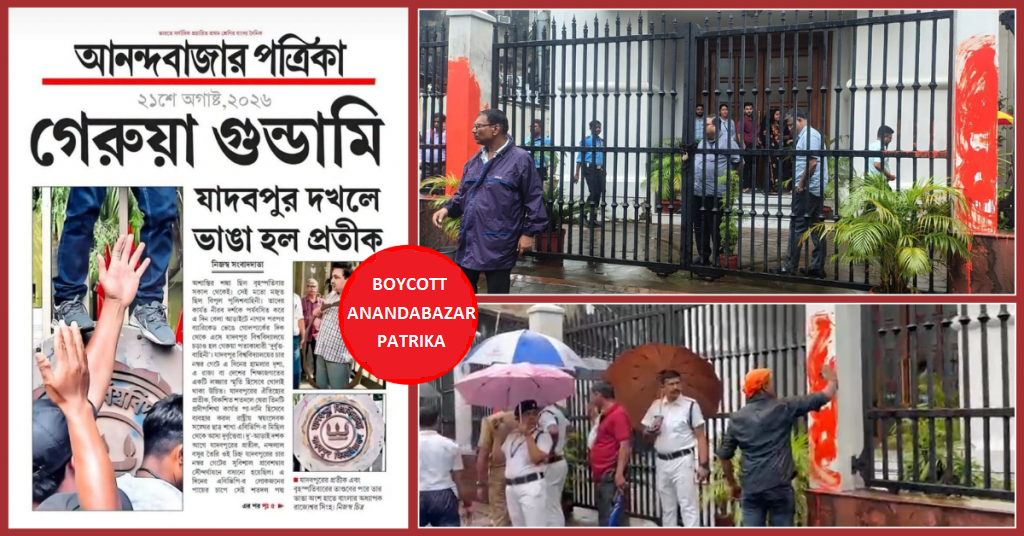
Sayan Pal |HENB | Kolkata | September 2, 2026:: A controversy over the use of the phrase “Gerua gundami” (saffron hooliganism) to describe violence at Jadavpur University escalated on Tuesday, September 1, when a group of saffron-clad protesters demonstrated outside the Kolkata office of Anandabazar Patrika and painted parts of the newspaper’s white gate pillars saffron.
The protest came days after the Bengali daily published a front-page report using the headline “Gerua Gundami: Logo broken during raid on JU campus” in its August 21 edition. The report referred to a confrontation at Jadavpur University involving activists of the Akhil Bharatiya Vidyarthi Parishad (ABVP) and the Students’ Federation of India (SFI), during which the university emblem on the gate was reportedly damaged.
The headline triggered strong criticism from sections of the Hindu community and Hindutva organisations, who argued that associating the sacred saffron colour with “hooliganism” was derogatory and offensive to Hindu religious and cultural sentiments.
Saffron-clad protesters target ABP office
Videos from Tuesday’s demonstration showed two men painting saffron on pillars at the main entrance of the Anandabazar Patrika office while several police personnel stood nearby. Some police officers were also seen recording the incident on their mobile phones.
A larger group of protesters, many wearing saffron clothing or headscarves, gathered outside the office and raised slogans such as “Bhagwa ka apmaan nahi sahega” (“We will not tolerate the insult of Bhagwa”) and “Anandabazar Patrika haye haye.”
According to an editor of Anandabazar Patrika, the demonstration began at around 1:30 p.m. and continued for nearly an hour.
In another video, protesters were heard addressing a gathering and declaring: “This land belongs to Shyama Prasad Mukherjee. This land belongs to Swami Vivekananda. This land is saffron.”
Additional footage from the scene showed protesters raising slogans in Hindi and Bengali near the newspaper’s main gate before police escorted them away.
After the protesters left, the newspaper reportedly repainted the gate pillars white.
‘Gerua Gundami’ headline sparks political controversy
The protest followed a sharp political controversy over the newspaper’s August 21 headline. Anandabazar Patrika had used the expression “Gerua gundami”, literally translating to “saffron hooliganism”, in its report on the Jadavpur University incident.
The wording drew criticism from West Bengal Chief Minister Suvendu Adhikari, who demanded an apology from the newspaper. Adhikari argued that saffron carries deep religious and cultural significance and that the expression was inappropriate and insulting.
A few days later, while speaking at a public event, Adhikari said that the newspaper should apologise for its use of the expression. He also indicated that saffron-clad monks could protest if the newspaper failed to do so.
The controversy subsequently moved beyond political criticism, with a police complaint being filed against members of the newspaper’s editorial team.
FIR against senior journalists
Kolkata Police registered an FIR at Bowbazar police station against Anandabazar Patrika editor Ishani Dutta Roy, chief reporter Soma Mukherjee, and other members of the editorial team following a complaint by Sanjay Shastri Maharaj.
The complainant alleged that the headline could hurt Hindu sentiments and disturb public peace. He described the wording as “highly objectionable, derogatory, misleading and offensive”.
The complaint also called for an investigation into the editorial process behind the headline, including who proposed the expression, who approved it, who edited the report and who determined the headline.
The FIR has drawn criticism from journalists and media organisations, which have called for its withdrawal and expressed concern over what they view as pressure on the press.
Protest, press freedom and the question of religious sensitivity
The episode has opened a wider debate over the limits of editorial language when reporting on politically and religiously sensitive issues.
Critics of Anandabazar Patrika argue that the phrase “Gerua Gundami” was not merely a description of alleged violence by particular individuals but rhetorically linked the colour saffron—deeply associated with Hindu spirituality, renunciation and religious tradition—with hooliganism. They contend that such terminology risks offending the sentiments of millions of Hindus and unnecessarily injecting a religious dimension into political reporting.
At the same time, journalists and media organisations have defended the principle of editorial independence and argued that criticism of a newspaper should not result in criminal proceedings against its editorial staff.
The controversy therefore presents two competing concerns: the protection of freedom of expression and the responsibility of media organisations to exercise sensitivity when using religiously charged terminology.
Adhikari invokes ‘nation first’ principle
The controversy unfolded on the same day that Adhikari announced an increase in the monthly social-security pension for retired journalists from ₹2,500 to ₹5,000, with immediate effect. He also launched the distribution of health cards under the Mukhyamantri Swasthya Bima Yojana.
Addressing media professionals, Adhikari stressed that freedom of speech is guaranteed by the Constitution but said that it must be exercised alongside the principle of “nation first.” He urged journalists to avoid expressions that, in his view, could weaken the country or hurt religious sentiments.
The juxtaposition was notable: while the government announced measures aimed at supporting journalists, a major Bengali newspaper was simultaneously at the centre of a political and legal controversy over its editorial language.
Tagore quote follows saffron protest
Following Tuesday’s protest, the editor of Anandabazar Patrika posted a line from Rabindranath Tagore’s celebrated poem “Where the Mind Is Without Fear” on Facebook: “Uccha jetha shir…” (“Where the head is held high…”).
The post came amid a controversy that has increasingly come to symbolise the tension between press freedom, political confrontation and religious sensitivities in West Bengal.
The immediate controversy began with two words—“Gerua Gundami”—but has since developed into a broader confrontation involving the newspaper, the state government, Hindutva organisations, journalists and the police.
For critics of the newspaper, the episode is a reminder that saffron is not merely a political colour but carries centuries-old religious and civilisational significance. For media organisations, however, the FIR against editorial personnel has raised concerns about whether strong or controversial journalistic language should become the basis for criminal proceedings.
The dispute is therefore likely to continue well beyond the repainting of the newspaper’s gate pillars, with the larger questions of religious sensitivity, editorial responsibility and freedom of the press remaining at the centre of the controversy.
Following the controversy, there have been widespread calls on various social media platforms to boycott Ananda Bazar Patrika.
…
_Vodeo courtesy: BBC Bangla Instagram.


 Struggle for Hindu Existence
[…] announced framework allows Rs. 1,00,000 for low-budget Pujas. Do not treat that amount as cash in hand until your…
[…] missionary expansion an unfinished conquest of India gives forceful expression to a Hindu civilizational fear. The phrase can identify…
[…] development is clear but should be stated precisely. As of 7 September 2026, the BAPS mandir was presented as…
[…] [Disclaimer: The content in this RSS feed is automatically fetched from external sources. All trademarks, images, and opinions belong…
[…] Yatindranand Giri has asked RSS to clarify its definition of Hindutva after Mohan Bhagwat’s MSG speech while describ…. That…