

[…] of September 17, 2026, a complaint had been filed seeking an FIR against Sanjay Azad and a girl described…

Struggle for Hindu Existence
*Hindu Rights to Survive with Dignity & Sovereignty *Join Hindu Freedom Movement to make Bharat Hindu Rashtra within this lifetime *Jai Shri Ram *Jayatu Jayatu Hindu Rashtram *Editor: Upananda Brahmachari.
HfHR’s New Leadership: Hindu Rights or Anti-Hindutva Politics?
HfHR Under Scrutiny: Hindu Rights Advocacy or an Anti-Hindutva Political Platform?
New Leadership Signals a More Organised Campaign Against Hindus, Hindutva, RSS and Hindu Nationalist Politics…
Upananda rahmachari | HENB | New Delho | , Sept 15, 2026:: The latest leadership restructuring of Hindus for Human Rights (HfHR) has brought renewed attention to a fundamental ideological question within the global Hindu diaspora: is HfHR primarily a Hindu human-rights organisation, or has it evolved into an organised progressive political platform whose central mission is to challenge Hindutva, the RSS and Hindu nationalist politics?
The question assumes greater significance with HfHR’s September 14 announcement of a new leadership structure and its declaration that the organisation is entering a new phase of the “progressive Hindu movement.” The restructuring brings together HfHR’s human-rights advocacy, electoral mobilisation and theological-cultural work under an increasingly coordinated institutional framework.
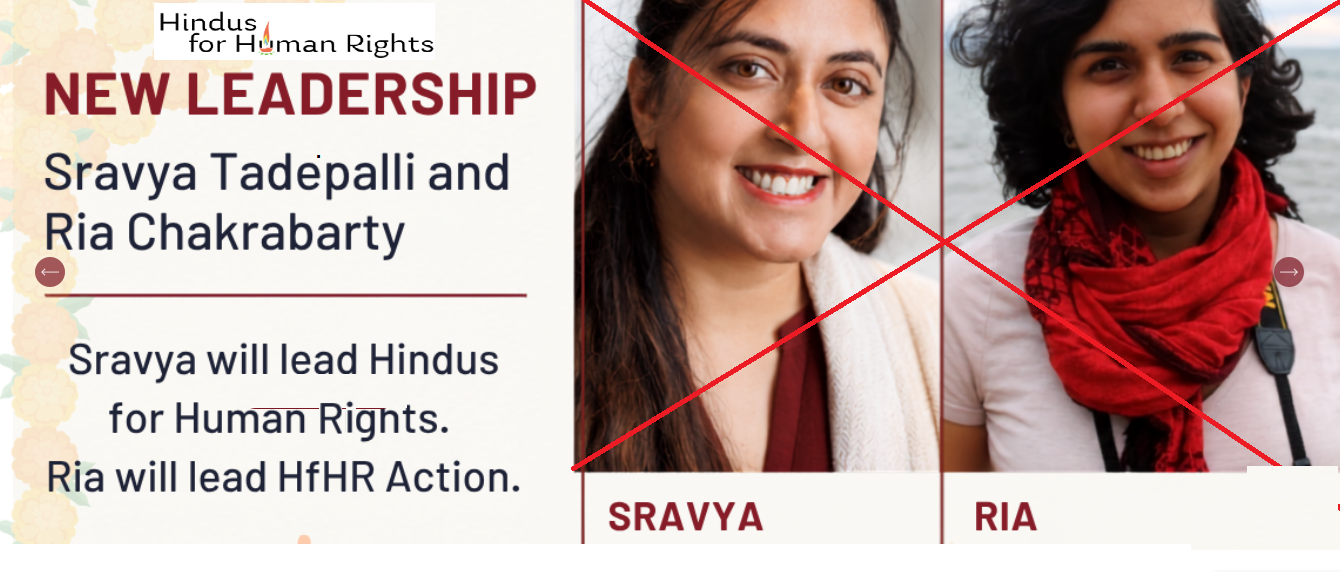
Under the new arrangement, Sravya Tadepalli is set to lead HfHR as Executive Director, while Ria Chakrabarty heads the separately incorporated Hindus for Human Rights Action, the organisation’s 501(c)(4) political arm. Co-founder Sunita Viswanath moves into the positions of Executive Director Emeritus and Board Chair while continuing her strategic role with Samadarshini, described by HfHR as a progressive Hindu project. Co-founder Raju Rajagopal will serve as Strategic Advisor.
HfHR itself describes the new structure as three interconnected spheres: human-rights advocacy and coalition-building through HfHR; electoral and political engagement through HfHR Action; and theological, spiritual and cultural work through Samadarshini.
The significance is unmistakable. What began as a diaspora advocacy initiative has developed into a network seeking to influence American politics, public policy and the very definition of Hindu political identity in the West.
An Organisation That Openly Opposes Hindutva
HfHR’s opposition to Hindutva is neither incidental nor a recent development.
The organisation explicitly identifies Hindutva and religious nationalism among the forces it opposes and has consistently sought to distinguish what it calls progressive, pluralist Hinduism from Hindu nationalist politics.
Its activism became particularly visible around the 2021 “Dismantling Global Hindutva” conference, which HfHR supported while arguing that Hindutva should be examined as a political ideology distinct from Hinduism.
Since then, its campaigns, publications and public statements have repeatedly targeted the ideological and political influence of Hindutva in India and among sections of the Hindu diaspora.
HfHR’s own recent publications leave little ambiguity about its priorities. Its 2026 resource archive includes articles explicitly addressing the “growing tide of Hindutva” in the United States, the politics of Hindu Americans, the alleged weaponisation of “Hinduphobia,” and what it calls Hindu nationalist influence in the diaspora.
This is therefore not simply a disagreement over terminology. HfHR has consciously positioned itself as a progressive Hindu alternative to Hindu nationalism.
The RSS and Mohan Bhagwat, Modi Have Become a Major Target
The organisation’s campaign against the Rashtriya Swayamsevak Sangh (RSS) has intensified dramatically in 2026.
When RSS chief Mohan Bhagwat travelled to North America and the United Kingdom, HfHR organised an extensive opposition campaign.
On August 29, it organised a New York rally outside Madison Square Garden titled “Hindus Say No to the RSS: Rally for a Secular, Interfaith India.” The organisation called upon Hindus and allies to reject the RSS and described its Hindu nationalist vision as threatening Muslims, Christians, Sikhs, Dalits and others.
Days earlier, HfHR had organised a City Hall campaign involving Hindu, Muslim, interfaith and civil-rights organisations to oppose Bhagwat’s appearance. Its press release explicitly framed the campaign as opposition to the spread of Hindu nationalism and RSS influence in the United States.
HfHR subsequently sent an open letter to the Mayor of London demanding opposition to Bhagwat’s UK visit, describing the RSS in extraordinarily hostile terms and urging British faith and interfaith leaders not to participate in events associated with the RSS chief.
For critics within the Hindu diaspora, this sustained campaign is central to the argument that HfHR has become an anti-Hindutva political platform operating under a Hindu identity.
HfHR rejects that characterisation. It argues that opposing Hindutva is compatible with being Hindu and that Hinduism cannot be equated with Hindu nationalism.
But the organisation’s own record demonstrates that opposition to Hindutva is not a peripheral issue—it is one of the defining pillars of its public activism. As usual, HfHR’s stance on Modi remains unequivocally hostile.
From Opposition to Political Mobilisation
The most consequential development, however, may be the transformation of this ideological opposition into organised electoral politics.
HfHR Action has become an explicit political vehicle for translating its progressive Hindu agenda into American electoral and policy engagement.
In August, HfHR Action and SACRED Acts announced that nearly 100 US political leaders and candidates across eight states had pledged to reject political contributions associated with the RSS. The signatories included federal, state and local political figures.
HfHR Action’s own announcement describes the initiative as an effort to prevent RSS-linked organisations and individuals from exercising political influence in the United States. Ria Chakrabarty said the pledge represented a rejection of what she called Hindu majoritarianism and Christian nationalism.
The campaign demonstrates how far HfHR has moved beyond conventional human-rights advocacy. It is now actively attempting to shape who receives political legitimacy and influence within American politics.
Its political arm has also endorsed candidates for Congress. In May 2026, HfHR Action endorsed Saikat Chakrabarti, presenting him as a progressive candidate who would oppose Hindu nationalism and challenge what HfHR characterised as authoritarianism in both the United States and India.
The organisation has similarly endorsed Pramila Jayapal, describing her as a Hindu voice opposed to Hindu nationalism and supporting what it calls a progressive foreign policy.
The message is therefore clear: HfHR is not merely criticising Hindutva—it is attempting to build political power against it.
Sravya Tadepalli: Continuity Rather Than Change
Against this background, the elevation of Sravya Tadepalli assumes particular importance.
Tadepalli has been associated with HfHR for several years and has worked on policy, legislative advocacy and Hindu educational initiatives. HfHR’s own media profile describes her expertise as encompassing Hinduism, Hindu liberation theology, Hindu nationalism and public policy affecting Hindus and South Asian Americans.
Her writings and public advocacy have consistently reflected the organisation’s progressive interpretation of Hinduism and its opposition to Hindu nationalism.
Her appointment therefore appears less like an ideological departure and more like institutional consolidation of HfHR’s existing direction.
Ria Chakrabarty’s elevation to head HfHR Action similarly places political mobilisation at the centre of the organisation’s next phase.
Sunita Viswanath’s continuing senior strategic role provides another element of continuity. Her public record includes sustained criticism of Hindutva and Hindu nationalist politics.
Taken together, the appointments suggest that HfHR intends to expand rather than dilute its existing ideological programme.
Modi, BJP and the Broader Hindu Nationalist Movement
The organisation’s opposition is not confined to the RSS as an institution.
HfHR’s public advocacy has repeatedly targeted Prime Minister Narendra Modi, the BJP-led political establishment and policies associated with Hindutva.
Its 2026 publications include criticism of the Modi government, while its political arm describes itself as challenging Hindu nationalism and authoritarianism in both India and the United States.
HfHR’s archive also contains extensive material on Kashmir, the Citizenship Amendment Act, caste, religious freedom, minority rights and the Ayodhya/Ram Janmabhoomi dispute.
Its treatment of the Ayodhya issue illustrates the ideological divide particularly sharply. HfHR has repeatedly framed the demolition of the Babri Masjid and the Ram Janmabhoomi movement primarily through the lens of Hindu nationalist mobilisation and communal violence.
For supporters of Hindutva, this represents a fundamental misreading of the historical and civilisational claims surrounding Ayodhya. For HfHR, it is part of a larger argument that Hindu identity should be separated from majoritarian political nationalism.
That disagreement goes to the heart of the controversy surrounding the organisation.
The Bangladesh and Pakistan Question
One criticism sometimes levelled against HfHR is that it does not adequately defend Hindus facing persecution in Muslim-majority countries such as Bangladesh and Pakistan.
The available record, however, is more nuanced.
HfHR has explicitly condemned anti-Hindu violence in Bangladesh. In October 2021, it issued a statement describing attacks on Hindu homes, shops, shrines and Durga Puja installations as horrific violence and called for justice and accountability.
It also participated in a US civil-society initiative concerning violence against minorities in Pakistan. In 2023, HfHR joined a coalition that wrote to Pakistan’s ambassador following the killing of Hindu doctor Birbal Genani and other violence against religious minorities.
Its Bangladesh activity did not end with 2021. Following the political upheaval in Bangladesh in 2024, HfHR acknowledged reports of attacks on Hindu houses and businesses and called for protection of minorities and justice for victims.
The criticism, therefore, is better framed differently.
The dispute is not whether HfHR has ever condemned attacks on Hindus abroad—it demonstrably has—but whether the organisation gives comparable political energy and institutional priority to Hindu persecution outside India as it gives to opposing Hindutva, the RSS and Hindu nationalism.
HfHR’s own “Hinduphobia” statement reveals the ideological framework behind its approach. While acknowledging documented persecution of Hindus in Pakistan and Bangladesh, the organisation rejects what it calls attempts to use “Hinduphobia” discourse to advance Hindu nationalism in the United States.
This distinction is precisely where its critics part company with it.
For sections of the Hindu diaspora, the principal human-rights concern is the protection of Hindus as a historically persecuted community in several parts of South Asia and elsewhere. They argue that the Hindu-rights movement should be prepared to confront anti-Hindu persecution regardless of the political consequences.
HfHR, by contrast, approaches the question through a broader framework of minority rights, pluralism, caste, democracy and opposition to majoritarian politics.
The West Bengal Example
HfHR’s approach was also visible in its response to post-election violence in West Bengal.
Following the 2026 state election, HfHR condemned political violence but said it had found no verifiable reports of attacks specifically targeting Hindus and highlighted what it described as false or doctored claims circulating online. It also characterised the election result as a rejection of the BJP’s “divisive, sectarian messages.”
Supporters would regard this as responsible fact-checking and resistance to communal misinformation.
Critics, however, see such responses as evidence of a recurring pattern: HfHR is quick to scrutinise claims that could strengthen the Hindu nationalist narrative while placing greater emphasis on alleged abuses or majoritarianism associated with Hindu political mobilisation.
That difference in interpretation has helped fuel the perception among sections of the Hindu diaspora that HfHR’s priorities are fundamentally different from those of Hindu nationalist organisations.
The Chinmoy Krishna Das Test
The case of Hindu monk Chinmoy Krishna Das presents a significant test of HfHR’s human-rights advocacy. Das, a prominent voice for Bangladesh’s Hindu minority, has remained in detention after being arrested in November 2024 on sedition charges and subsequently facing several other cases, including a murder-related case. Supporters have described the proceedings as politically motivated, while the allegations remain before Bangladeshi courts. In September 2026, he was granted only five hours’ parole to attend the funeral of his mother, Sandhya Rani Dhar.
HfHR has repeatedly spoken about violence against Hindus in Bangladesh and Pakistan, including the killing of Hindu garment worker Dipu Chandra Das. However, in the publicly available HfHR material reviewed for this report, no comparable campaign calling for Chinmoy Krishna Das’s release has been identified. This stands in contrast to HfHR’s explicit advocacy for the release of activists such as Umar Khalid and Sharjeel Imam, whose prolonged detention it has described as unjust.
For critics, the contrast raises a pointed question: does HfHR apply the same human-rights standard when the detained individual is a Hindu monk whose activism challenges Islamist pressure in Bangladesh? The organisation would likely answer that its opposition to Hindutva does not diminish its commitment to Hindu rights. But until HfHR speaks with equal clarity for Chinmoy Krishna Das, the case will remain a powerful question mark over whether its human-rights advocacy is truly about defending Hindus—or primarily about defining which kind of Hindu politics it is willing to defend.
Who Speaks for Hindu Americans?
The deeper conflict is therefore not simply between two political organisations. It is a contest over representation itself.
HfHR argues that Hindu Americans are politically diverse and that no organisation, including the RSS or its affiliates, can claim to speak for all Hindus.
Its critics agree with the first proposition but challenge the second part of the equation: they argue that HfHR itself should not be treated as the authentic progressive representative of Hindu Americans merely because it operates under the Hindu banner.
This contest has become increasingly visible in the United States, where Hindu-American organisations are now divided over questions involving India, Hindu nationalism, caste, religious freedom, Kashmir, the Modi government, the RSS and the meaning of Hindu identity in American public life.
HfHR has chosen its side clearly.
Its stated vision is a progressive, pluralist and anti-caste Hinduism that rejects Hindu nationalism.
The alternative vision advanced by Hindu nationalist organisations places greater emphasis on Hindu civilisational identity, cultural nationalism, the historical experiences of Hindus and the political assertion of Hindu interests.
The confrontation between these two visions is increasingly being played out not only in India but also in American universities, civil-society networks, interfaith organisations, media platforms and electoral politics.
A New Phase in the Hindu Diaspora’s Ideological Battle
The September 14 leadership announcement should therefore be viewed against this larger backdrop.
HfHR is no longer simply a small diaspora organisation issuing statements on human rights. It has developed a multi-layered institutional structure encompassing advocacy, electoral politics, theological engagement, political endorsements, coalition-building and campaigns against the RSS.
Its own public record shows that the organisation intends to challenge Hindu nationalism not only in India but also wherever it believes Hindutva is gaining influence among the diaspora.
Its supporters describe this as an effort to rescue Hinduism from majoritarian politics and reclaim the faith’s traditions of pluralism, equality and justice.
Its critics see something very different: an organised progressive political network using Hindu identity to challenge the political, cultural and institutional influence of the RSS and the broader Hindutva movement among Hindus in the West.
The disagreement is ultimately about more than HfHR.
It concerns the future definition of Hindu identity in the global public sphere.
Can Hinduism be separated from Hindutva? Should Hindu advocacy primarily defend Hindus as a community, or should it place Hindu concerns within a universalist minority-rights framework? Can an organisation oppose Hindu nationalism while simultaneously claiming to represent Hindu interests? And who, ultimately, has the authority to speak for Hindu Americans?
HfHR’s new leadership appears determined to answer those questions in its own way.
With Sravya Tadepalli taking the organisational helm, Ria Chakrabarty leading its political arm, and Sunita Viswanath retaining a senior strategic role, the organisation is positioned to intensify its campaign for a progressive Hindu political constituency in the West.
For the Hindutva movement and its supporters, the development represents another front in the growing ideological contest over Hindu representation outside India.
For HfHR, it is an opportunity to build a counterweight to what it regards as the globalisation of Hindu nationalism.
The battle, therefore, is no longer merely over whether Hindutva should be supported or opposed. It is increasingly a battle over who gets to define Hinduism, who speaks for Hindus, and what “Hindu interests” themselves mean in the rapidly changing politics of the global Hindu diaspora.
..
_Internal sources and Agency Inputs.
One comment on “HfHR’s New Leadership: Hindu Rights or Anti-Hindutva Politics?”
Leave a comment

 Struggle for Hindu Existence
Pingback: Hindus for Human Rights: Leadership and Political Position – DharmaRenaissance Blog