

[…] an Ashok Singhal birth-centenary event in Kolkata, Suvendu pledged a UCC and laws framed around "love jihad" and "land…

Struggle for Hindu Existence
*Hindu Rights to Survive with Dignity & Sovereignty *Join Hindu Freedom Movement to make Bharat Hindu Rashtra within this lifetime *Jai Shri Ram *Jayatu Jayatu Hindu Rashtram *Editor: Upananda Brahmachari.
Hindutva student group ABVP Moves to Block Umar Khalid Documentary Screening.
ABVP Seeks Cancellation of Umar Khalid Documentary Screening at NLSIU, Citing ‘Political Propaganda’ and Alleged Anti-National Activities.
B Upendran | HENB | Bengaluru | Sept 16, 2026: A controversy has erupted at the National Law School of India University (NLSIU) in Bengaluru over a proposed screening of filmmaker Lalit Vachani’s documentary Prisoner No. 626710 Is Present, which focuses on the incarceration of former Jawaharlal Nehru University (JNU) student activist Umar Khalid.
The Akhil Bharatiya Vidyarthi Parishad (ABVP), a student organisation affiliated with the Rashtriya Swayamsevak Sangh (RSS), has demanded that NLSIU cancel the screening, arguing that academic campuses should remain spaces for learning and national integrity rather than become platforms for political or ideological propaganda. The documentary had been scheduled for September 14 as part of a programme marking six years since Khalid’s arrest.
The controversy comes as Khalid completes six years in custody under the Unlawful Activities (Prevention) Act (UAPA). He was arrested by the Delhi Police Special Cell on September 14, 2020, in connection with the investigation into the February 2020 northeast Delhi riots, in which 53 people were killed and hundreds injured. Authorities have alleged that he was part of a larger conspiracy behind the violence. Khalid has denied the allegations and has not been convicted.
ABVP Objects to Screening
ABVP Bengaluru Secretary Abhinandan Mirji said the organisation had formally approached the NLSIU administration seeking cancellation of the programme. The organisation argued that the screening could amount to the glorification of civil unrest and political mobilisation.
ABVP has also referred to Khalid’s association with the 2016 JNU slogans controversy, protests surrounding the execution of Parliament attack convict Afzal Guru, and his alleged role in mobilisation during the anti-CAA/NRC protests and the Delhi riots.
The organisation’s objection has been accompanied by a separate intervention from lawyer Girish Bharadwaj, who wrote to NLSIU Vice Chancellor Sudhir Krishnaswamy seeking cancellation of the screening.
According to reports, ABVP also indicated that it would continue pressing the university to cancel the event even after the screening was postponed.
Screening Postponed, Organisers Cite Security Concerns
The proposed screening was subsequently postponed by NLSIU’s Law and Society Committee (LawSoc). The organisers said the postponement was due to logistical and security considerations and maintained that the programme would be held later in the same trimester.
LawSoc also denied that it had withdrawn the programme because of pressure from ABVP. It said the objective was to ensure that the screening could take place in a safe and responsible manner. The committee had planned the event around questions concerning pre-trial detention, bail, dissent, political incarceration, criminal law and democratic freedoms.
Sources cited by Bar & Bench said the postponement was linked to security arrangements because September 14 coincided with Ganesh Chaturthi, while ABVP maintained that its opposition had contributed to the decision.
Six Years Without Conviction
Khalid’s imprisonment has become a major point of contention between supporters who portray him as a political prisoner and critics who point to the serious allegations brought against him.
He has been detained under the UAPA, a stringent national-security law. The prosecution has accused him of involvement in a broader conspiracy connected with the 2020 Delhi violence. Khalid has denied the charges.
His supporters, meanwhile, argue that prolonged pre-trial incarceration raises questions about civil liberties, due process and the use of anti-terror legislation against political activists.
The controversy has consequently acquired significance beyond the proposed film screening, touching upon the competing claims of national security, academic freedom, political dissent and the rights of an accused person before conviction.
A majority of people from nationalist groups are demanding stricter action against Umar Khalid and his fellow student activists, who are alleged to have been involved in various subversive activities, including an alleged plan to sever the “Chicken’s Neck” corridor from the rest of the country in an effort to separate the northeastern states from India.
Allegations Surrounding JNU Activities
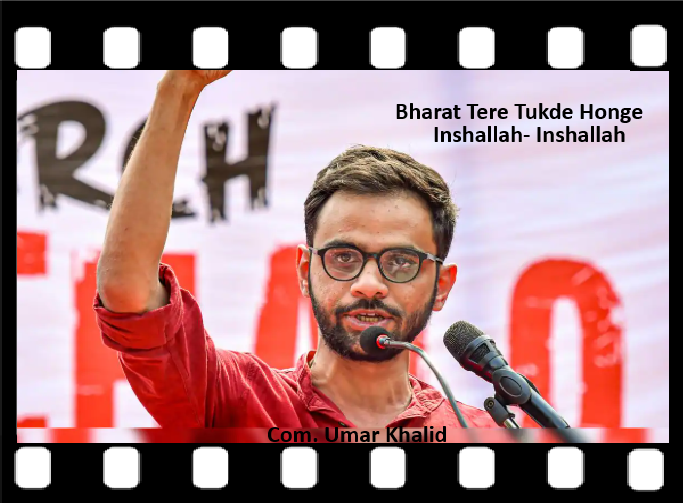
Among the allegations cited by critics of Khalid are his alleged association with the controversial slogan “Bharat Tere Tukde Honge – Inshallah Inshallah” during the 2016 JNU controversy and claims that separatist sentiments concerning Kashmir and India’s northeastern region were promoted in student spaces.
However, such claims are matters to be distinguished from established judicial findings. The 2016 JNU episode itself involved a separate controversy over slogans allegedly raised on campus, and Khalid’s subsequent legal proceedings have concerned different allegations, including those arising from the 2020 Delhi riots.
ABVP has invoked these controversies while opposing what it regards as the public glorification of Khalid through documentaries and campus events.
ABVP also demanded action against the producer of the documentary, Lalit Vachani, under the UAPA and other relevant provisions concerning sedition, alleging that he attempted to portray the alleged criminal activities of a serious offender in a favourable light, contrary to the sentiments of patriotic citizens, and with what the organisation described as an improper intention.
Another Campus Controversy at JNU
The NLSIU dispute follows a separate controversy at Jawaharlal Nehru University last month concerning Khalid’s book, Fractured Communities: Adivasi Histories and the Politics of Power.
JNU cancelled the booking of its SSS-1 auditorium for an August 10 discussion of the book. The university said the event details submitted with the venue request were incomplete. The organisers subsequently sought an alternative venue.
The development added another layer to the debate over whether academic institutions should host discussions involving Khalid while he remains imprisoned.
Father Defends Khalid
Khalid’s father, Syed Qasim Rasool Ilyas, has criticised the ABVP’s campaign against the documentary. He argued that his son has not been convicted and therefore should be regarded as innocent under the law.
“Until a court convicts a person, they are considered innocent in the eyes of the law,” Ilyas said.
He also questioned why Khalid continues to remain behind bars six years after his arrest without the trial having reached a conclusion.
CAA Protests and Delhi Violence
Khalid was among activists prosecuted in cases arising from the wider political mobilisation against the Citizenship Amendment Act (CAA), which was enacted in 2019.
The CAA provides a pathway to Indian citizenship for specified non-Muslim religious communities from Afghanistan, Bangladesh and Pakistan who meet the statutory requirements. Critics of the legislation have argued that its exclusion of Muslims, particularly when considered alongside proposed citizenship-verification measures, could have discriminatory consequences.
The anti-CAA protests subsequently became intertwined with the investigation into the February 2020 Delhi violence. Police alleged that some activists involved in the protest movement were part of a broader conspiracy behind the violence. Khalid has denied the allegations against him.
Ilyas has maintained that activists who participated in the anti-CAA movement were subsequently implicated in the Delhi violence and has questioned the continued detention of his son without a completed trial.
A Wider Battle Over Campus Politics
The NLSIU controversy therefore goes beyond a single documentary. At its centre is a sharply contested question: whether a university should provide a platform for discussion of an imprisoned activist accused in a serious national-security case, or whether such a programme risks turning an academic space into a vehicle for political advocacy.
For ABVP, the proposed screening represents what it describes as political propaganda and an inappropriate glorification of civil unrest. For Khalid’s supporters and organisers, the event provides an opportunity to discuss pre-trial detention, civil liberties, dissent and the functioning of India’s criminal-justice system.
The postponement has not ended the dispute. ABVP has continued to seek cancellation, while the organisers have said the screening will be rescheduled. The episode thus adds a new chapter to the long-running controversy surrounding Umar Khalid—one that now extends from the courtroom and prison system into the campuses where questions about nationalism, dissent, academic freedom and the limits of political expression continue to collide.
..
_Agency Inputs.
One comment on “Hindutva student group ABVP Moves to Block Umar Khalid Documentary Screening.”
Leave a comment


Pingback: Umar Khalid Documentary Dispute: A Campus Speech Test – DharmaRenaissance Blog