
Struggle for Hindu Existence
*Hindu Rights to Survive with Dignity & Sovereignty *Join Hindu Freedom Movement to make Bharat Hindu Rashtra within this lifetime *Jai Shri Ram *Jayatu Jayatu Hindu Rashtram *Editor: Upananda Brahmachari.
Hindutva Is Steadily Advancing in Nepal with the Aim of Restoring a Hindu Rastra.
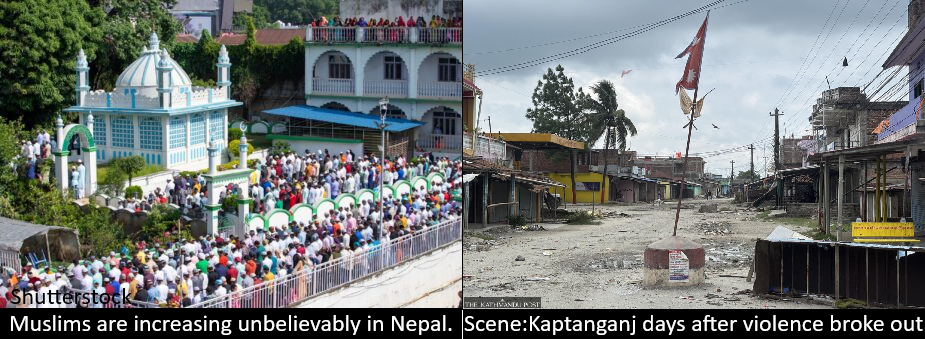
Nepal’s Hindu Rashtra Debate Gains New Momentum Amid Rising Religious Polarisation.
From the Tarai-Madhesh to Kathmandu, religious identity is becoming increasingly visible in Nepal’s politics — reviving a long-running debate over whether the Himalayan nation should return to its former Hindu-state status.
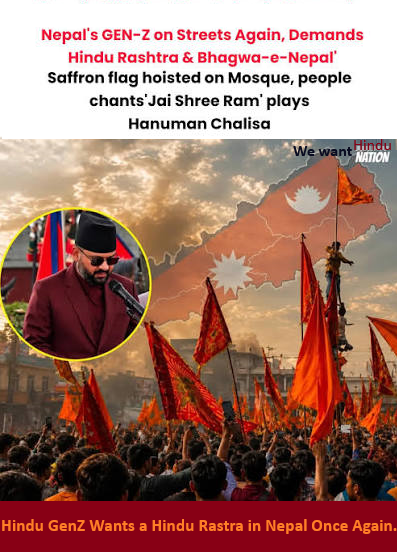 Upendra Bharti | HENB | New Delhi | Sept 22, 2026:: A confrontation that began with loud music during a Hindu religious procession in Nepal’s eastern Sunsari district in July has developed into a wider debate over religious polarisation, political mobilisation and the future of the country’s secular identity.
On the night of July 26, Hindu devotees returning from the Koshi Barrage with holy water for the Bol Bam pilgrimage became involved in a dispute with members of the local Muslim community in Kaptanganj, in Dewanganj Rural Municipality-3. According to police and local reporting, objections were raised over loud music played during the procession. The confrontation escalated, police intervened, and firearms were eventually used. One person was initially reported killed, while subsequent monitoring by Nepal’s human-rights organisation INSEC recorded three deaths and 25 injuries connected with the incident.
The incident did not remain confined to the village.
Tensions subsequently spread to other parts of the Tarai-Madhesh region, prompting protests, restrictions and heightened security. Prime Minister Balendra Shah later chaired a National Security Council meeting that reviewed the Sunsari violence and called for stronger coordination to preserve social harmony and national unity.
The Kaptanganj episode has therefore become more than a local dispute. It has become a window into a deeper transformation in Nepal: the growing political salience of religious identity in a country that has been constitutionally secular since the end of the monarchy.
A Local Dispute With Wider Resonance
The immediate circumstances of the Kaptanganj confrontation involved both religious flags and loudspeakers.
A detailed Kathmandu Post investigation reported that tensions had already been building around religious flags placed near a Shiva temple. Local Hindu residents had reportedly requested their removal, while community representatives said attempts had been made to prevent the dispute from escalating. On July 26, Hindu youths reportedly removed some existing flags and replaced them with flags bearing images of Hanuman before the Bol Bam procession.
Later that evening, devotees preparing for the pilgrimage gathered near the Shiva temple with loudspeakers. The dispute over the music eventually developed into violence.
The episode illustrates how apparently minor disagreements over flags, processions, religious music or public space can acquire a much wider communal meaning when Hindu and Muslim identities become attached to them.
It also demonstrates the growing importance of social media. Reports from the area indicate that some people reached the scene after watching videos of the confrontation circulating on their mobile phones. Once local incidents are recorded and shared online, a dispute involving a few hundred people can rapidly become part of a much larger narrative of religious confrontation.
Nepal’s Long Hindu Past
The present debate cannot be understood without considering Nepal’s history.
For centuries, Nepal’s political identity was closely associated with Hinduism and monarchy. Scholarly work on modern Hinduism in Nepal notes that the Nepali state had claimed a Hindu identity since its creation in the mid-18th century, while the explicit politicisation of that identity intensified during the period from 1960 to 1990.
The 1962 Constitution formally established Nepal as a Hindu kingdom. The 1990 constitutional settlement, which followed the People’s Movement, introduced constitutional monarchy but retained the country’s Hindu-state character.
That arrangement ended during the political upheavals of the 2000s.
Following the Maoist insurgency and the political transformation of 2006–07, Nepal moved towards republicanism and secularism. The monarchy was subsequently abolished, and the 2015 Constitution established Nepal as an “independent, indivisible, sovereign, secular, inclusive, democratic, socialism-oriented, federal democratic republican state.”
At the same time, the Constitution gives Nepal’s secularism a distinctive definition. Article 4 explains secularism as including protection of religion and culture “being practiced since ancient times” together with religious and cultural freedom. The Constitution also guarantees freedom to profess, practice and protect religion while prohibiting acts such as forced conversion and conduct that disturbs public peace.
Thus, Nepal’s constitutional framework contains both secular republicanism and an explicit recognition of its historical religious and cultural traditions.
That combination remains politically sensitive.
The Hindu Rashtra Question
The demand for restoring Nepal as a Hindu state did not disappear with the abolition of the monarchy.
In 2015, during the drafting of the current Constitution, groups campaigned for Nepal to be declared a Hindu state. The proposal was rejected by the Constituent Assembly, and the final Constitution retained secularism.
Since then, royalist and Hindu nationalist organisations have continued to advocate a return to some form of Hindu statehood.
The contemporary movement is not necessarily identical to the political system that existed before 2006. Different groups have advanced different combinations of objectives, including restoration of Hindu state status, protection of traditional religious practices, stronger opposition to religious conversion and, in some cases, restoration of the monarchy.
This distinction is important because the Hindu Rashtra movement in Nepal contains several overlapping constituencies rather than a single organisation or unified political programme.
The Indian Influence
The debate has also been shaped by developments in neighbouring India.
The rise of Hindu nationalist politics in India, particularly after the BJP came to national power in 2014, provided new visibility to the idea of Hindu civilisational politics across the region. Nepal’s open border with India, particularly with Uttar Pradesh and Bihar, has facilitated extensive movement of people, culture, commerce, religious practices and political ideas.
The relationship between communities on the two sides of the border is often described through the traditional phrase “roti-beti,” reflecting longstanding connections through marriage, trade, language and pilgrimage.
For Hindu nationalist activists, these links make Nepal an important part of a broader civilisational landscape.
Critics, however, argue that importing India’s communal political vocabulary into Nepal risks changing the character of a society that has historically contained considerable religious and cultural overlap.
The result is an increasingly contested political space.
RSS and HSS Networks
Another part of the debate concerns the activities of Hindu nationalist organisations.
The Hindu Swayamsevak Sangh (HSS), an organisation operating among Hindus outside India and associated ideologically with the Rashtriya Swayamsevak Sangh (RSS), has maintained a presence in Nepal.
The extent of its political influence is disputed. Some observers argue that its organisational network remains relatively small compared with the scale of Nepal’s population and social diversity. Others point to the increasing visibility of Hindu religious symbols, programmes and organisational activity as evidence of a broader cultural shift.
The distinction between cultural Hindu activism and political mobilisation is therefore increasingly important in understanding Nepal’s changing religious landscape.
Balendra Shah and a New Political Environment
The political environment changed significantly after the 2025 Gen Z uprising and the March 2026 parliamentary election.
Balendra Shah, leader of the Rastriya Swatantra Party (RSP), became Prime Minister on March 27, 2026. His swearing-in ceremony included Hindu Vedic rituals as well as Buddhist religious elements. Radio Nepal reported the participation of 108 Vedic students and Buddhist monks in the ceremony, while The Associated Press also described the oath ceremony as incorporating Hindu and Buddhist rituals.
The symbolism was notable because the ceremony took place under Nepal’s existing secular constitutional framework.
It does not, by itself, establish that Shah’s government supports restoration of a Hindu state. However, the prominence of religious ritual at the beginning of the new administration has become part of the wider public discussion about religion, culture and political identity in post-Gen Z Nepal.
The RSP’s emergence has also weakened the dominance of several traditional political parties. In the March 2026 election, the party secured 182 of the 275 seats in the House of Representatives, according to published election results.
This political realignment has created space for older parties and new political movements alike to reconsider how religious and cultural identity feature in political mobilisation.
Deuba, Oli and the Hindu Identity Question
The Hindu Rashtra debate also intersects with the politics of established parties.
Former Prime Minister Sher Bahadur Deuba and Communist Party of Nepal-Unified Marxist-Leninist (CPN-UML) chairman K.P. Sharma Oli have, at different times and in different ways, invoked Nepal’s Hindu heritage.
Oli has previously promoted the claim that the Hindu deity Ram was born in Nepal’s Thori area, rather than Ayodhya in India. The claim became particularly prominent during the period of heightened Nepal-India tensions following the 2015 blockade.
Such statements illustrate how Hindu cultural themes can be employed by politicians whose broader ideological positions are otherwise very different.
That development is significant because the Hindu Rashtra question is no longer confined exclusively to royalist or explicitly Hindu nationalist circles.
The Tarai-Madhesh: Nepal’s Communal Flashpoint
The Tarai-Madhesh is particularly sensitive because of its geography and demography.
The plains stretch along Nepal’s southern frontier and contain many of the country’s densely populated settlements. Hindu and Muslim communities have lived alongside each other for generations, sharing languages, markets, occupations and social networks.
The region is also directly connected to India’s Uttar Pradesh and Bihar.
That proximity means religious developments in India can quickly acquire resonance in Nepal. Hindu religious processions, saffron flags, Muslim religious flags, loudspeakers and public festivals increasingly operate not only as expressions of faith but, in some localities, as markers of communal presence.
The Kaptanganj episode demonstrated the danger of that dynamic.
A dispute over where a flag is placed or how loudly a procession plays music can become interpreted as a contest over who controls a public space.
Once that happens, compromise becomes considerably more difficult.
Social Media and the New Communal Battlefield
The spread of smartphones and social media has added another dimension.
A decade ago, a dispute in a remote Tarai village could potentially have remained a local matter. Community elders, political representatives and local officials could intervene before it acquired a broader identity.
Today, a video recorded at the scene can circulate nationally within minutes.
Context is frequently lost. The original time and location may be unclear. Old videos can be presented as new incidents, while emotionally charged captions can turn a local confrontation into evidence of a supposedly nationwide religious campaign.
This mechanism works in both directions.
Hindu users can circulate material portraying Hindus as victims; Muslim users can circulate material portraying Muslims as victims. Each side can consequently become convinced that it is responding defensively to a much larger threat.
The result can be a self-reinforcing cycle of suspicion.
Conversion, Christianity and Demographic Anxiety
The Hindu Rashtra debate in Nepal is not limited to Hindu-Muslim relations.
Christian missionary activity and religious conversion have become major issues for Hindu nationalist and royalist groups, particularly in the country’s hill regions.
Supporters of stricter controls argue that aggressive proselytisation and foreign-funded religious organisations threaten Nepal’s traditional culture. Opposition to conversion has consequently become an important component of campaigns for stronger protection of Nepal’s Hindu heritage.
Nepal’s Constitution itself prohibits converting another person from one religion to another and makes such conduct punishable by law.
At the same time, allegations concerning foreign financing, organised proselytisation or religious radicalisation require evidence on a case-by-case basis.
The same applies to claims about Muslim migration.
Claims circulating on social media that recent communal disturbances are primarily the result of Rohingya refugees entering Nepal require careful verification rather than assumption. Nepal has longstanding Muslim communities, particularly in the Tarai, and the country’s Muslim population predates recent refugee movements by many generations.
The State’s Response
The Kaptanganj violence has also raised questions about the capacity of the Nepali state to prevent communal conflict.
The government established a five-member investigation committee immediately after the July 26 incident. The committee submitted its report to Home Minister Sudan Gurung on August 18. INSEC has separately called for an impartial investigation and accountability for those responsible.
The issue extends beyond crowd control.
Preventing communal violence requires local intelligence, trusted community intermediaries, rapid identification of inflammatory rumours and political leadership capable of intervening before a dispute becomes communal.
In border regions such as the Tarai-Madhesh, these mechanisms are particularly important because the social and economic links between Nepal and India make the rapid movement of people and information unavoidable.
A Movement With Multiple Strands
The contemporary Hindu Rashtra movement in Nepal therefore consists of several overlapping strands.
There are royalists who associate Hindu statehood with the restoration of the monarchy.
There are Hindu organisations that seek constitutional recognition of Nepal’s civilisational and religious heritage without necessarily advocating a return to the former political system.
There are activists focused on opposing religious conversion and missionary activity.
There are groups influenced by Hindu nationalist politics in India.
And there are ordinary Nepali citizens who identify strongly with Hindu culture but may not necessarily support any particular political programme.
These groups should not automatically be treated as one political bloc.
The Gyanendra Factor
Former King Gyanendra Shah remains an important symbolic figure for Nepal’s royalist and Hindu-state advocates. Although the monarchy was abolished in 2008, Gyanendra continues to be associated with sections of the movement advocating the restoration of both the monarchy and Nepal’s Hindu-state identity.
Against this backdrop, Hindu Rashtra advocate Upananda Brahmachari has played a notable role in efforts to strengthen the campaign for restoring Nepal as a Hindu Rashtra.
As reported, in November 2014, Brahmachari met former King Gyanendra Shah at his residence, Nirmal Niwas, in Kathmandu, during his Hindu Rashtra campaign (Abhiyan) in Nepal. The meeting was reportedly focused on the broader objective of rebuilding Nepal as a Hindu Rashtra and exploring ways to strengthen the movement for the restoration of its Hindu civilisational identity.
Brahmachari subsequently held meetings with prominent Nepali political figures, including Khum Bahadur Khadka of the Nepali Congress and Kamal Thapa of the Rastriya Prajatantra Party-Nepal (RPP-N), as part of efforts to broaden support for the Hindu Rashtra cause.
These reported engagements placed Brahmachari among the activists seeking to connect Nepal’s Hindu Rashtra campaign with the country’s royalist, political and religious constituencies. His initiative also reflected an attempt to build a wider platform around the restoration of Nepal’s Hindu identity rather than limiting the movement to any single political organisation.
The campaign has continued to attract attention among Hindu organisations in subsequent years. Delegations associated with the Hindu Janajagruti Samiti, led by Dr Charudutta Pingale, have also held meetings with stakeholders involved in Nepal’s Hindu Rashtra movement. In 2022, Pingale publicly reiterated the organisation’s support for restoring Nepal as a Hindu Rashtra.
The involvement of Brahmachari and other Hindu organisations indicates that the Hindu Rashtra demand in Nepal has developed over several years and has involved interactions among religious activists, royalist circles and political figures. The movement, however, remains distinct from the official constitutional position of Nepal, which continues to define the country as a secular federal democratic republic.
What Lies Next?
Nepal’s constitutional position remains clear: it is a secular federal democratic republic. At the same time, the Constitution explicitly recognises the protection of religion and culture practised since ancient times and guarantees religious and cultural freedom.
The political debate is therefore not simply a contest between “Hindu” and “secular” identities.
It is also a debate over what secularism should mean in a society whose historical institutions, festivals, cultural traditions and public life have been deeply shaped by Hinduism and Buddhism.
The July violence in Sunsari has added urgency to that debate.
The immediate issue is communal peace. The longer-term issue is whether religious identity will increasingly become a principal instrument of political mobilisation.
Nepal’s political history provides examples of major ideological transitions—from monarchy to constitutional democracy, from Hindu kingdom to secular republic, and from traditional parties to a new generation of political movements.
The emerging Hindu Rashtra debate represents another potential turning point.
Whether it ultimately develops into a constitutional campaign, a royalist movement, a cultural revival, a broader Hindu nationalist mobilisation—or remains one strand among several competing visions of Nepal’s national identity—will depend on the choices made by Nepali citizens, political parties, religious organisations and the country’s constitutional institutions.
For now, the evidence points to a debate that is becoming more visible, more organised and increasingly intertwined with the country’s rapidly changing political landscape.
Hindu Rashtra Again? A Debate Moving Back to the Centre
The question of whether Nepal should once again become a Hindu Rashtra is no longer confined to royalist organisations or religious groups. The demand has re-entered Nepal’s mainstream political discourse, with sections of the Nepali Congress, pro-monarchy forces, Hindu organisations and other political actors publicly debating the country’s religious and civilisational identity. In August 2026, a faction of the Nepali Congress led by former Prime Minister Sher Bahadur Deuba adopted a proposal to promote Sanatan Dharma as a national identity, although the move also exposed significant differences within the party.
This development has given fresh political relevance to a demand that has existed for years. In 2014, Nepali Congress leader Khum Bahadur Khadka had already established a 25-member committee seeking to restore Nepal’s Hindu-state identity under the slogan “Nation, Nationality and Sanatan Hindu State.” At the time, the Nepali Congress formally supported secularism, making Khadka’s initiative an important indication of the internal debate over Nepal’s religious identity.
Upananda Brahmachari’s Early Hindu Rashtra Initiative
Against this wider background, Hindu Rashtra advocate Upananda Brahmachari emerged as one of the activists seeking to build an organised campaign for the restoration of Nepal’s Hindu identity.
As reported, in November 2014, Brahmachari met former King Gyanendra Shah at his residence, Nirmal Niwas, in Kathmandu, during his Hindu Rashtra expedition (Abhiyan) in Nepal. The meeting was aimed at discussing the broader strategy for rebuilding Nepal as a Hindu Rashtra and strengthening the campaign for restoring the country’s historic Hindu civilisational identity.
Brahmachari also met Khum Bahadur Khadka of the Nepali Congress and Kamal Thapa of the Rastriya Prajatantra Party-Nepal (RPP-N) during the same period, seeking to connect the Hindu Rashtra campaign with political leaders and organisations sympathetic to the restoration of Nepal’s Hindu identity. Contemporary material published by Hindu Janajagruti Samiti in November 2014 also recorded Brahmachari’s participation in the campaign for a traditional Hindu state and identified Khadka’s initiative to press for the restoration of Nepal’s Hindu-state status.
The significance of those initiatives can be understood more clearly in retrospect. What was then largely a campaign led by religious activists and a section of political leaders has subsequently become part of a broader national discussion about Nepal’s constitutional identity.
The Argument for a Hindu Rashtra
Supporters of a Hindu Rashtra advance several arguments. The first is historical continuity. Nepal was formally described as a Hindu constitutional monarchy under the 1990 Constitution, which defined the country as a “Hindu, constitutional monarchical kingdom.” For proponents, restoring Hindu Rashtra would therefore represent not the creation of an entirely new national identity, but the constitutional recognition of a civilisational tradition that shaped Nepal’s history, festivals, institutions, pilgrimage centres and public culture for centuries.
The second argument concerns cultural protection. Supporters contend that a Hindu Rashtra could provide stronger constitutional and institutional protection for Nepal’s temples, religious traditions, Sanskrit heritage, pilgrimage routes, festivals, sacred sites and Sanatan practices. This argument does not necessarily require the denial of religious freedom to other communities; proponents increasingly present the concept as a framework in which Nepal’s Hindu civilisational character would coexist with guarantees for Buddhists, Kirats and other religious communities.
There is also a constitutional argument. Nepal’s present Constitution itself defines secularism in terms that include religious and cultural freedoms and the protection of religion and culture handed down from time immemorial. It also guarantees every person the freedom to profess, practise and protect their religion and gives religious denominations rights concerning their religious sites and trusts. Supporters of Hindu Rashtra consequently argue that recognition of Nepal’s Hindu civilisational heritage need not automatically mean removal of religious liberty; they advocate a model combining a Hindu national identity with equal legal protection for other faiths.
A further argument advanced by proponents concerns conversion and demographic change. Nepal’s Constitution prohibits religious conversion, while Article 26 also prohibits acts carried out in the exercise of religious freedom that convert another person from one religion to another. Hindu Rashtra advocates argue that a stronger constitutional emphasis on Nepal’s indigenous religious traditions could reinforce safeguards against coercive or inducement-based conversion while protecting the country’s traditional religious composition.
A Hindu Identity Without Religious Exclusion?
One of the central questions for the Hindu Rashtra movement is whether the concept can be articulated as a civilisational identity rather than a system of religious exclusion.
Its proponents increasingly point to Nepal’s long interaction between Hinduism and Buddhism and argue that Sanatan traditions historically accommodated multiple schools, sects and practices. The current constitutional debate within the Nepali Congress illustrates this argument. The five-point proposal promoted by the Deuba faction in August 2026 called for Sanatan religion to be promoted as a national identity while also pledging protection for Hindu, Buddhist, Kirat and nature-based religious traditions and maintaining religious freedom.
This formulation is significant because it places the Hindu Rashtra question beyond the narrower issue of restoring the monarchy. A Hindu state and a constitutional monarchy are often linked by Nepal’s royalist movement, but they are not necessarily identical constitutional propositions. The contemporary debate therefore encompasses at least three separate questions: whether Nepal should remain secular or adopt a Hindu-state identity; whether the monarchy should be restored; and what constitutional safeguards should govern the rights of religious minorities.
From the Past to the Present
The revival of the debate in 2025–26 indicates that the issue has not disappeared from Nepalese political life. In 2025, pro-monarchy forces regrouped around demands for the restoration of the Hindu kingdom, while the Hindu-state question also resurfaced within the Nepali Congress. In May 2025, political figures and analysts were already acknowledging renewed public interest in Sanatan Dharma and Hindu culture, while Rastriya Prajatantra Party-linked forces made restoration of the Hindu kingdom a central political demand.
By August 2026, the issue had moved further into mainstream party debate. The proposal within the Deuba faction to recognise Sanatan religion as a national identity demonstrated that the question was being discussed not merely by royalist organisations but also within one of Nepal’s historic democratic parties. At the same time, opposition from other Nepali Congress leaders showed that the country remains sharply divided over the constitutional implications of such a change.
Thus, the Hindu Rashtra debate is now part of a larger argument over history, national identity, cultural preservation, religious freedom and the constitutional future of Nepal.
Gen Z Movement and the Rise of Hindu Sentiment
Nepal’s Gen Z movement of 2025 marked a significant turning point in the country’s political and social landscape. What began as a youth-led movement against the political establishment and governance-related grievances developed into a much broader national upheaval, eventually contributing to a major political transition and the elections of March 2026.
The movement also created a new environment for the discussion of Nepal’s Hindu identity. During and after the Gen Z mobilisation, Hindu sentiments became increasingly visible in sections of the public discourse, particularly among groups arguing that Nepal’s historical identity as a Hindu nation had been weakened by the post-2006 political transformation.
For Hindu Rashtra advocates, the Gen Z movement was significant because it demonstrated growing dissatisfaction with aspects of the existing political order and opened space for renewed debate over Nepal’s historical, cultural and religious identity. The movement brought younger generations into the centre of national politics and, according to Hindu Rashtra supporters, created an opportunity to reconsider the country’s transition from a Hindu kingdom to a secular republic.
The movement also witnessed expressions of Hindu and traditional cultural identity, including greater public visibility of religious symbols, rituals and calls for the preservation of Sanatan traditions. Supporters of the Hindu Rashtra cause interpreted these developments as evidence that the demand for restoration of Nepal’s Hindu identity had not disappeared among younger Nepalis.
At the same time, the Gen Z movement cannot be characterised solely as a Hindu Rashtra movement. Its principal drivers included broader grievances concerning governance, corruption, political accountability, employment, restrictions on social media and dissatisfaction with established political parties. The Hindu identity debate subsequently became one strand within the wider political realignment.
The movement nevertheless had an important indirect consequence for the Hindu Rashtra debate. It weakened the assumption that Nepal’s post-2008 secular republican framework had permanently settled the question of national identity. The subsequent political environment allowed questions concerning Hindu heritage, monarchy, Sanatan culture, religious conversion and constitutional secularism to re-enter public discussion.
Hindu organisations and Hindu Rashtra advocates have consequently viewed the Gen Z upheaval as a moment when a younger generation began questioning inherited political assumptions and looking again at Nepal’s historical and civilisational identity. In this interpretation, the movement did not itself establish a Hindu Rashtra agenda, but it helped create political space in which the question of restoring Nepal’s Hindu identity could once again be openly debated.
The developments following the movement—including the political transition and the emergence of new political forces in 2026—have therefore added a new dimension to Nepal’s long-running debate over whether its future national identity should remain secular or once again formally recognise its Hindu civilisational heritage.
Reports of Muslim Families Seeking Safety Across the Border
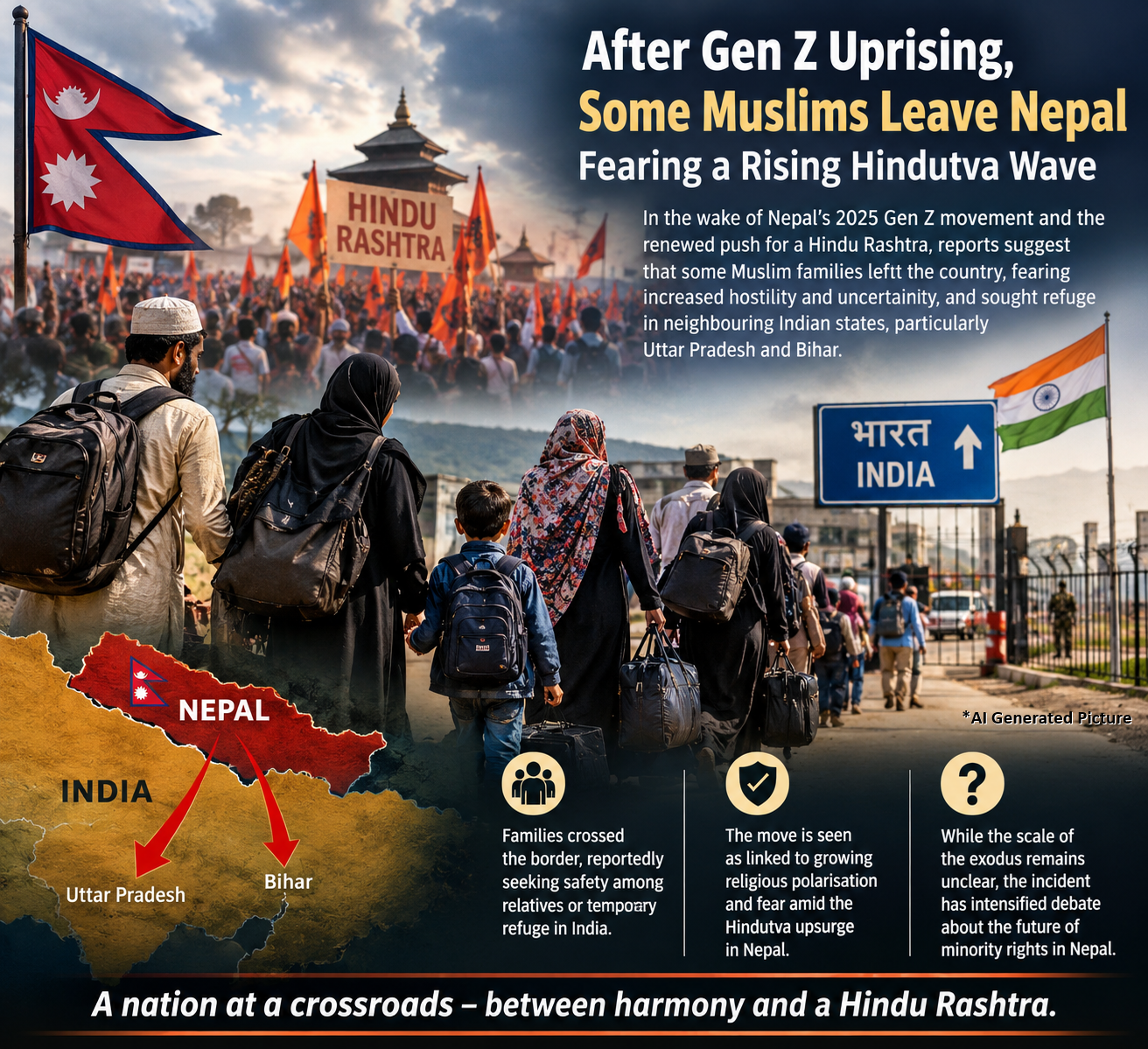
Amid the turmoil surrounding Nepal’s 2025 Gen Z uprising, reports and claims circulated that some members of Nepal’s Muslim community, fearing the effects of a renewed Hindu-nationalist or Hindutva current, left affected areas and crossed into neighbouring Indian territory, particularly Uttar Pradesh and Bihar, seeking safety among relatives or temporary refuge. However, available contemporary reporting does not independently establish the scale of such movement or confirm that people were systematically forced out because of their religion. The episode nevertheless became part of the wider debate over whether Nepal’s post-Gen Z political realignment could intensify competing claims over the country’s Hindu civilisational identity and the place of religious minorities within it.
The Road Ahead
Nepal’s present Constitution continues to define the country as a secular, inclusive, federal democratic republic, meaning that restoration of a Hindu-state identity would require a major constitutional and political process rather than an administrative decision.
For Hindu Rashtra advocates, however, the central argument is that Nepal’s constitutional identity should reflect the country’s historical and civilisational inheritance more explicitly. They contend that a nation can protect the religious freedom of all citizens while simultaneously recognising the tradition that has played the largest historical role in shaping its temples, festivals, sacred geography, literature, philosophy and national culture.
The trajectory from the campaigns of 2014, including Upananda Brahmachari’s reported meetings with former King Gyanendra Shah, Khum Bahadur Khadka and Kamal Thapa, to the renewed political debate of 2025–26 demonstrates that the demand has persisted across political cycles. Contemporary developments within the Nepali Congress have further brought the question back into national political discussion.
Whether Nepal ultimately chooses to retain its secular republican framework or revisits its Hindu-state heritage remains a matter for Nepal’s citizens, political institutions and constitutional process. What is increasingly clear, however, is that the idea of Hindu Rashtra has re-emerged as a significant question in Nepal’s continuing debate over what kind of nation it wants to be—and how its modern constitutional order should relate to its deeply rooted Hindu civilisational heritage.


you misspelled Israel
[…] 26 September 2026, a dispute had formed around the reported participation of HfHR activists in a New York protest…
[…] known procedural facts are that a division bench rejected a PIL seeking Durga Puja on the High Court rooftop,…
[…] discipline does not weaken Hindu advocacy. It makes it credible. In the current confrontation, Hindu groups are demanding scrutiny…
[…] clearest lesson from the Madras High Court is narrow but important: a return to Hinduism must be established through…