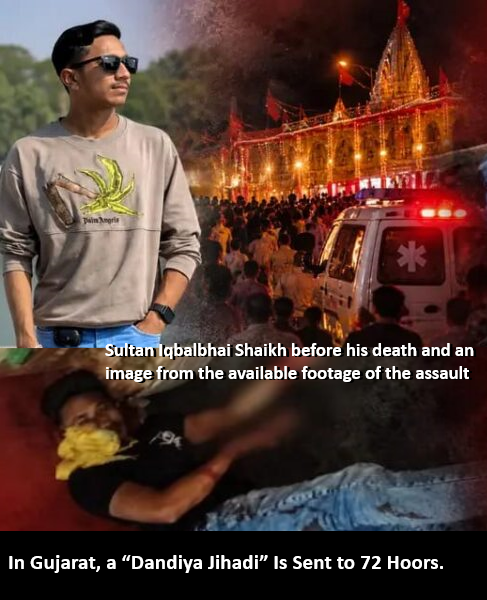


[…] The narrow factual frame available on 19 October 2026 is this: a Muslim student died after a violent clash…

Struggle for Hindu Existence
*Hindu Rights to Survive with Dignity & Sovereignty *Join Hindu Freedom Movement to make Bharat Hindu Rashtra within this lifetime *Jai Shri Ram *Jayatu Jayatu Hindu Rashtram *Editor: Upananda Brahmachari.
Gujarat: Muslim Student Dies After Dandiya Entry Dispute; 16 Face Police Action in Dakor Clash.
Muslim Student Dies in Gujarat After Violent Clash with Hindu Men Over Alleged Violation at Navratri Dandiya Festival.
Upendra Bharti | HENB | Dakor (Kheda district) Gujarat | October 19, 2026: A 21-year-old Muslim student, Sultan Iqbalbhai Shaikh, died following a violent confrontation near a Navratri Dandiya event in Dakor, Gujarat’s Kheda district, on the night of October 14. The incident reportedly involved a dispute over entry to the Hindu religious celebration, questions about the student’s identity, and an exchange with event organisers before violence broke out.
Sultan sustained a fatal neck injury during the confrontation near Satyam Society in the Navi Nagari area. His father, Mohammad Iqbal Shaikh, was also seriously injured. The incident has raised questions about the circumstances that led to the violence, the conduct of those involved, and the time taken to provide emergency medical assistance.
According to information gathered by ground reporters from attributed sources, Sultan allegedly attempted to enter the Dandiya event using a Hindu name and declined to show his Aadhaar card when asked to establish his identity. The reported exchange subsequently escalated into a confrontation with people associated with the event.
Alleged Identity Misrepresentation and Exchange Over Entry
The reported dispute centred on Sultan’s alleged attempt to gain entry to the Dandiya celebration using a Hindu identity. When asked to produce his Aadhaar card, he allegedly refused.
According to the accounts obtained by reporters, event organisers questioned his presence and reportedly asked him to return with female members of his family, including his sister, if applicable. The exchange allegedly became more contentious when Sultan made remarks about Muslim men’s access to Hindu women.
The exchange reportedly heightened tensions around the event. However, the exact sequence connecting the dispute to the physical assault, including who initiated the violence and who inflicted the fatal injury, remains a matter for investigation.
The allegations concerning the use of a Hindu name, refusal to produce Aadhaar identification, and remarks about Hindu women are central to understanding the reported dispute.
Political Disagreement Also Reported as a Trigger
Some local media accounts have linked the confrontation to a disagreement over voting patterns in the previous municipal election and support for an independent candidate.
According to these reports, an argument between rival groups escalated into a street confrontation involving sharp weapons. The incident reportedly left eight people injured: five from the Muslim side and three from the opposing group. Gujarat First also reported that a woman was among those injured.
The competing accounts leave open whether the political disagreement, the dispute over entry to the religious celebration, or both contributed to the confrontation. Investigators will need to establish the relationship between these reported developments.
Family Questions Delay in Medical Assistance
Sultan’s family has disputed any characterisation of the incident as a simple mutual clash. Relatives maintain that Sultan and his father were attacked first and have questioned the response they received after the violence.
Speaking to local media, Sultan’s uncle, Altaf, said the loud music from nearby Navratri celebrations made it difficult to understand what was happening during the incident.
“It all happened at night. We really couldn’t figure out what exactly went on,” he said.
The family alleged that an ambulance took approximately 30 minutes to arrive after it was called. Relatives said female members of the family tried to assist Sultan while waiting for medical help but were unable to stop the bleeding from his serious neck wound.
Footage circulated on social media reportedly showed Sultan lying on the ground with a severe neck injury. He was subsequently taken to a hospital in Nadiad, where he was declared dead, according to his relatives.
The reported delay in emergency assistance is a separate issue from the circumstances of the assault. Establishing the ambulance call time, dispatch records, arrival time, and hospital treatment would help determine the timeline of the emergency response.
Police Register Complaints From Both Sides
Kheda Superintendent of Police Vijay Patel said legal action had been initiated against 16 people in connection with the incident. Eight people from each side were reportedly detained, and police registered complaints from both groups.
Additional security personnel were deployed in Dakor to prevent further tensions.
The police action indicates that investigators are examining the incident involving both groups. The final findings will need to establish the roles of the individuals involved, the sequence of the confrontation, and the circumstances surrounding Sultan’s death.
Questions That the Investigation Must Resolve
The incident raises several specific questions: Was entry to the Dandiya event the immediate trigger for the confrontation? Did the alleged identity dispute and reported exchange over Hindu women precede the physical violence? Who initiated the assault, and who caused Sultan’s fatal injury? Finally, was emergency medical assistance delayed, and, if so, what accounts for the delay?
These questions require evidence from witnesses, event organisers, available video footage, medical records, ambulance logs, and the police investigation.
Sultan’s death has brought the reported dispute near a Navratri celebration into sharp focus. The allegations concerning his attempted entry and the subsequent confrontation are significant to the account of events, while the family’s claim that Sultan and his father were attacked first must also be examined.
The case now hinges on establishing the facts and determining individual responsibility through the investigation and legal process.
…
_With Agency Inputs.
One comment on “Gujarat: Muslim Student Dies After Dandiya Entry Dispute; 16 Face Police Action in Dakor Clash.”
Leave a Reply


Pingback: Dakor Navratri Clash: Facts, Restraint and the Demand for Justice – DharmaRenaissance Blog